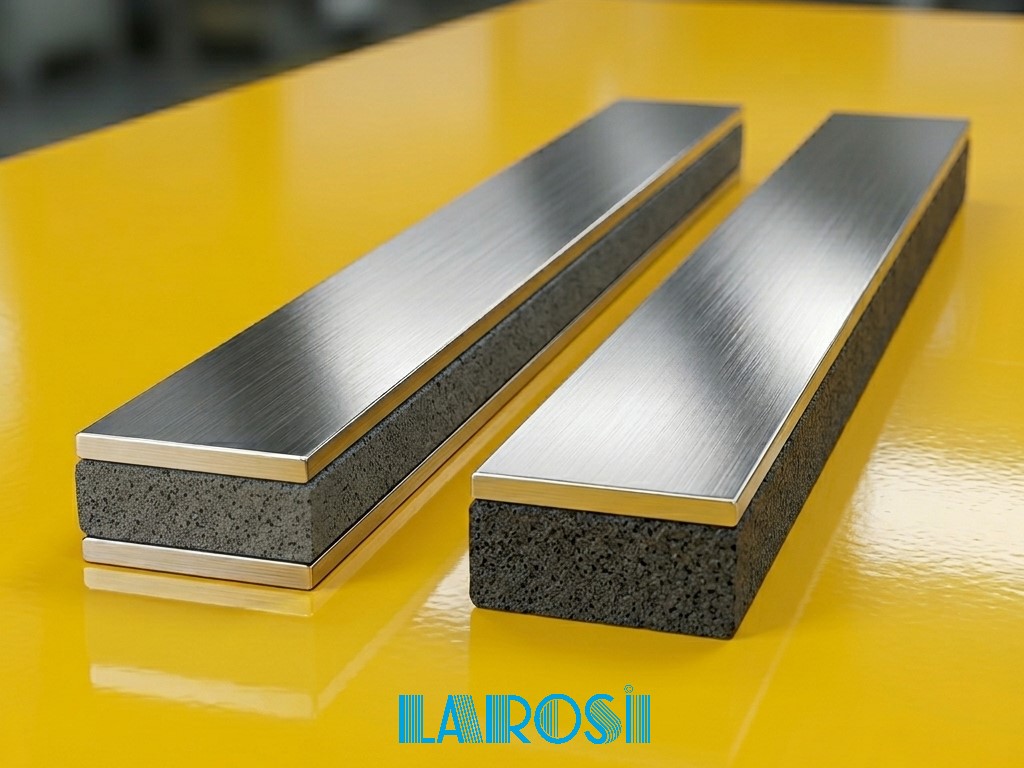
Selecting the correct rubber-metal rail requires the evaluation of several fundamental parameters. An error in specification can lead to component overload, loss of insulation effectiveness, or system resonance.
Main parameters to define
Static load: the total weight of the machine (or the portion bearing on a single support) determines the section and Shore hardness to be adopted. Under-loading leads to insufficient rubber deformation; overloading leads to excessive deformation and reduces damping capacity.
Excitation frequency: the frequency of the vibrations to be isolated (in Hz) is the most critical data point. To achieve good isolation, the natural frequency of the machine-support system must be at least 1.4–1.6 times lower than the excitation frequency. Low excitation frequencies (< 10 Hz) require very soft compounds or spring systems; higher frequencies (> 20 Hz) are well-managed with standard rubber.
Machine type and vibration profile: rotating machines (motors, fans) mainly generate harmonic vibrations at a fixed frequency; reciprocating machines (compressors, presses) generate broadband pulses. The vibration profile influences the choice of compound and hardness.
Operating environment: the presence of oils, hydrocarbons, or solvents suggests NBR compounds; high temperatures require EPDM or silicone compounds; environments with ozone or UV rays require specific protections.
Choosing between 1 and 2 metal sides
| Feature | 1 metal side | 2 metal sides |
|---|---|---|
| Flexibility and damping | High | Medium |
| Stability under load | Medium | High |
| Ease of installation | Simple | Requires bilateral access |
| Lateral force resistance | Limited | High |
| Typical applications | Light machinery, HVAC, motors | Compressors, generators, CNC |
| Relative cost | More affordable | Higher |
Rule of thumb: if the application involves heavy loads, intense vibrations, or the machine is subject to dynamic forces in multiple directions, always choose the 2 metal sides version. For everything else, the 1 side version of the rubber-metal rails offers the best balance between isolation and cost.
Comments are closed