The sandwich mount rubber-metal rails from Larosi Srl represent the immediate solution for those looking for reliable anti-vibration components, available in stock and ready for shipping.
Whether you need a sandwich mount rubber-metal rail with 1 metal side for light-duty applications or a version with 2 metal sides for heavy industrial plants, the immediate availability and fast delivery times make the difference — especially when every hour of machine downtime has a cost.
Catalog
Request our catalog of sandwich mount rubber-metal rails
Prices
Request prices in € and quotes for sandwich mount rubber-metal rails
Consultation
Contact us to request expert consultation from the Larosi team
What are sandwich mount rubber-metal rails
A sandwich mount rubber-metal rail is a structural isolation element composed of a layer of vulcanized elastomeric rubber bonded to one or two metal inserts (typically galvanized steel). Its linear geometry — unlike classic feet or cylindrical mounts — allows uniform load distribution along the entire length of the component, making it ideal for machine bases, crossbeams, and support structures in industrial equipment.
How it works
The elastomeric rubber is the core of the system: thanks to its ability to deform elastically under load, it absorbs mechanical vibrations generated by motors, compressors, pumps, and other machinery, converting vibrational energy into dissipated heat. The practical result is threefold:
- Vibration absorption: it reduces the transmission of mechanical energy to adjacent structures, protecting components from premature wear and material fatigue.
- Acoustic insulation: vibrations that are not transmitted become noise that is not generated, with a direct effect on reducing structural and airborne noise.
- Structural protection: the mechanical decoupling between the machine and its base preserves bolts, welds, and metal structures from cyclic stress that would otherwise lead to cracks or failures over time.
The sandwich mount rubber-metal rail is therefore not just a component for acoustic comfort: it is an engineering element with a direct impact on the service life and reliability of industrial plants.
Types of sandwich mount rubber-metal rails available
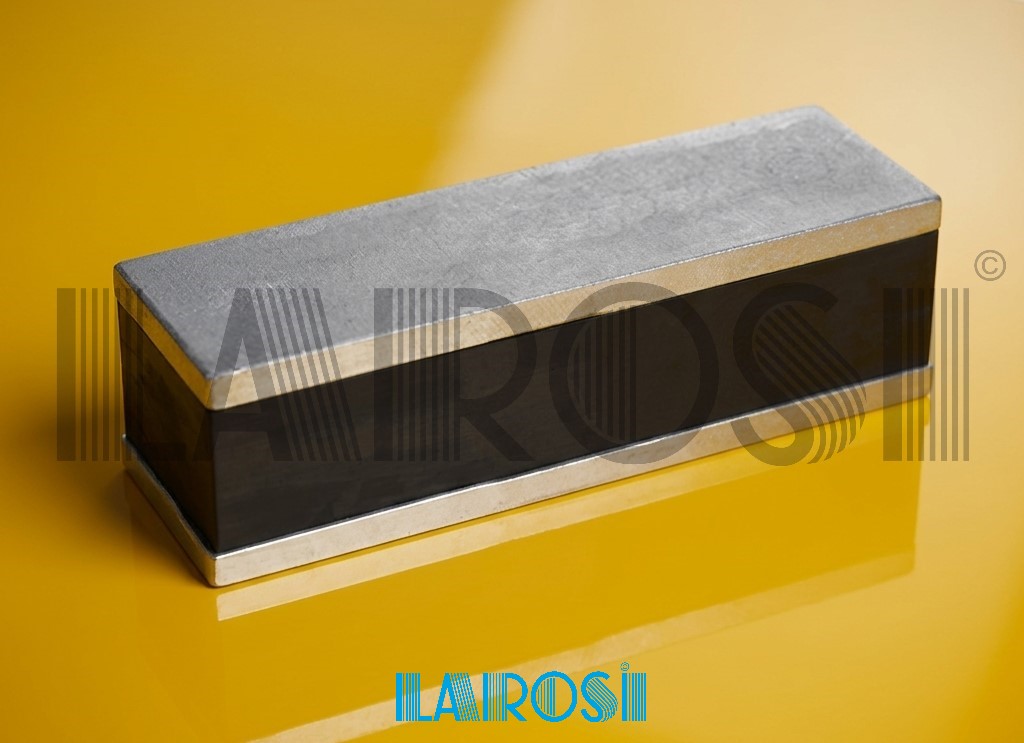
Larosi supplies both sandwich mount rubber-metal rails with 1 metal side and rails with 2 metal sides, guaranteeing immediate stock availability and fast delivery times across the entire country.
Larosi maintains high stock levels of sandwich mount rubber-metal rails ready in the most requested industrial sizes: order the sandwich mount rubber-metal rails you need now and avoid the typical lead times of custom products.
Standard-quality natural rubber sandwich mount rails with hardness of approximately 70°, 55° and 45° Shore. The mounts cover a load range from 300 N to 775 kN, depending on the profile type used and the length of the support.
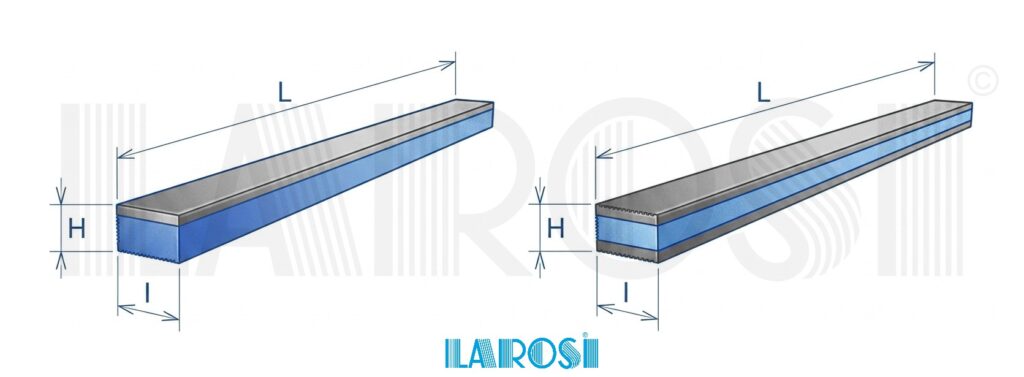
Sandwich mount rubber-metal rail with 1 metal side
The single-metal-side rail features a layer of elastomeric rubber bonded on one side only to a galvanized steel plate or sheet. The free rubber side is typically placed in contact with the support surface, while the metal plate is fixed to the machine frame by bolts or structural adhesive.
Typical applications:
- Low- and medium-power electric motors
- Industrial fans and extractors
- Small hydraulic and pneumatic pumps
- Laboratory equipment and instrumentation
- Residential and commercial HVAC systems
Main advantages:
- Greater flexibility and damping capacity
- Simplified installation with a single metal fixing point
- Affordable cost, ideal for quick maintenance replacements
When to choose the 1-side version: when the priority is to maximize vibration isolation and the application involves moderate loads with fixing constraints on one side only.
Sandwich mount rubber-metal rail with 2 metal sides
The double-metal-insert version features the elastomeric rubber sandwiched between two galvanized steel plates. Both metal faces provide bolted fixing points, ensuring a solid and well-defined bidirectional constraint.
Typical applications:
- Industrial compressors and refrigeration units
- Generators and power generator sets
- Presses, machine tools, and CNC machining centers
- Automated production lines
- High-flow pumping systems
- Metal structures subject to high dynamic loads
Main advantages:
- Greater system rigidity and dimensional stability under load
- Secure fixing on both faces, ideal for applications with lateral or tensile forces
- Predictable behavior under intense cyclic loads
- Suitable for installations where misalignment is critical
When to choose the 2-side version: when the machine generates intense vibrations, the structure requires rigid bilateral fixing, or the industrial context involves high loads and extended duty cycles.
Applications of sandwich mount rubber-metal rails
The sandwich mount rubber-metal rail is used in every industrial sector where rotating, reciprocating, or impulsive machinery is present. Below are the main application families, with the specific needs that the component solves.
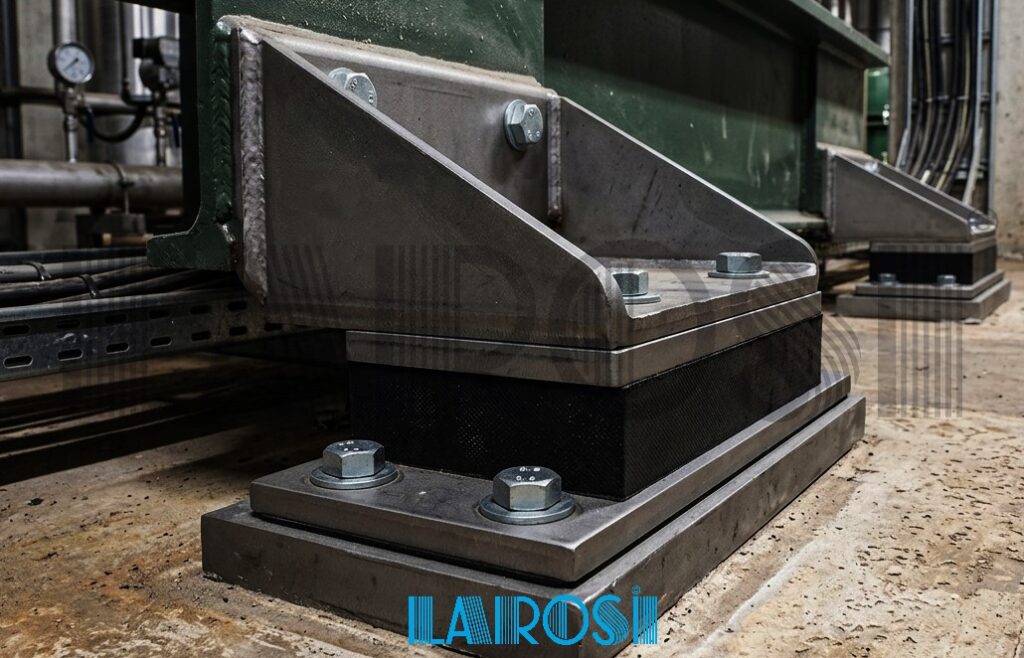
Industrial compressors
In reciprocating and centrifugal compressors, vibrations generated by the piston or blades are transmitted to the base and piping. Using sandwich mount rubber-metal rails on the support plane drastically reduces the transmission of these impulses, protecting joints and extending the service life of valves.
Typical case: vibration reduction on industrial air compressors installed on concrete slabs.
CNC machines and machining centers
Precise tool positioning depends on the dynamic rigidity of the system. Sandwich mount rubber-metal rails on the machine base filter external vibrations (adjacent production, vehicle traffic) without introducing static deflections, preserving machining quality.
Typical case: isolation on CNC machine bases in mechanical workshops.
Electric motors
Asynchronous motors generate harmonic vibrations linked to the power supply frequency and number of poles. Sandwich mount rubber-metal rails interrupt the propagation path toward the frame or carpentry, reducing noise and structural stress.
Hydraulic and pneumatic pumps
In hydraulic systems, pressure pulsations add to mechanical vibrations. Proper selection of the sandwich mount rubber-metal rail — based on the excitation frequency — prevents resonance phenomena that lead to pipe and fitting failures.
Generators and power generator sets
Power generator sets are broadband vibration sources. Their isolation is critical both in fixed applications and on wheeled or container-mounted units. The 2-metal-side rails are particularly suitable for withstanding shocks and transport accelerations.
HVAC systems
In heating plants, cold rooms, and air-conditioning systems, acoustic comfort is both a regulatory and functional requirement. Sandwich mount rubber-metal rails on fan coil, chiller, and air handling unit supports help meet the sound emission limits required by regulations.
Automated production lines
In series production systems, vibrations from one machine propagate to adjacent equipment, affecting product quality and the precision of artificial vision systems. Sandwich mount rubber-metal rails create mechanical discontinuities in the line, confining vibrations to the generation area.
Metal structures and industrial carpentry
In metal structures subject to dynamic loads (bridges, industrial walkways, automated warehouse racking), sandwich mount rubber-metal rails absorb load impulses and reduce fatigue in welded joints.
Materials and technical specifications
Elastomeric rubber
The rubber used in standard sandwich mount rubber-metal rails is an elastomeric compound based on NR (natural rubber) or NBR (acrylonitrile-butadiene), selected according to the application field:
- Shore A hardness: standard rails are typically available with hardness between 50 and 70 Shore A. Lower values (45–55 Shore) provide greater damping but lower static load capacity; higher values (65–75 Shore) are preferable for high loads with moderate damping.
- Dynamic behavior: the ratio between dynamic and static stiffness (Kdyn/Kstat) is a critical parameter for isolation design. In standard compounds this ratio is generally between 1.2 and 1.5.
- Resistance to chemical agents: NBR compounds offer good resistance to mineral oils, hydrocarbons, and hydraulic fluids, making them suitable for typical industrial environments.
- Operating temperature range: from –30°C to +80°C for standard compounds, with allowable peaks up to +100°C.
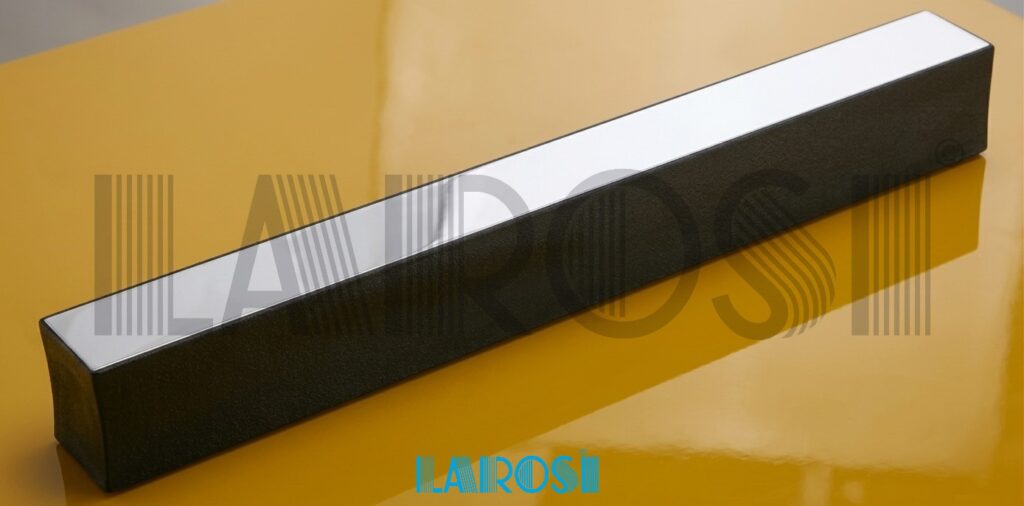
Metal insert
The metal insert(s) of the sandwich mount rubber-metal rails are made of galvanized steel (electrolytic or hot-dip galvanizing), which guarantees:
- Adequate corrosion resistance in humid industrial environments or with mild chemical agents
- High structural rigidity for bolted fixing
- Good weldability if structural integrations are required
Mechanical properties
| Property | Typical value |
|---|---|
| Shore A hardness | 50 – 70 Shore |
| Allowable static load | depends on section and length |
| Operating temperature | –30°C / +80°C |
| Resistance to mineral oils (NBR) | Good |
| Insert material | Galvanized steel |
Available dimensions
Larosi sandwich mount rubber-metal rails are available in a range of standard lengths and sections that cover the most common needs of the industrial market. The most common cross-sections range from compact profiles for light applications to more robust sections for heavy industrial use.
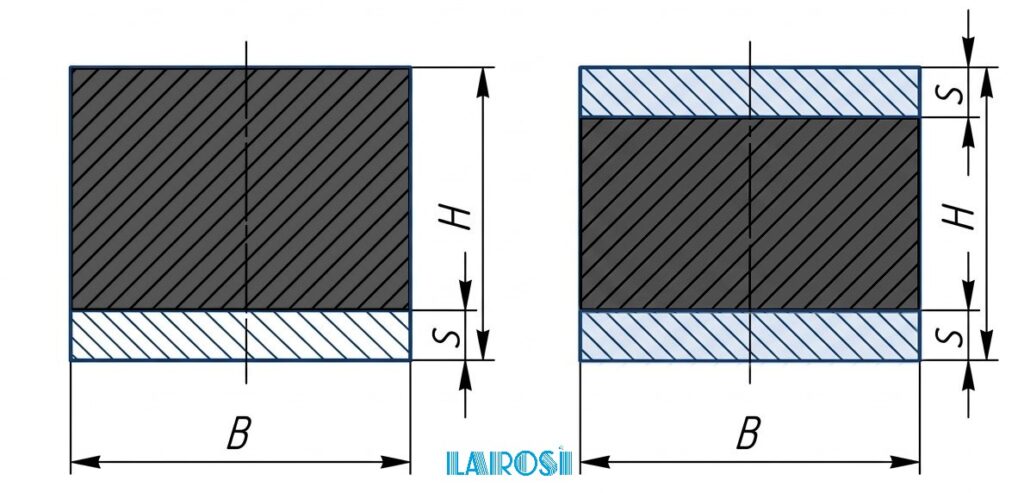
| B * H * L | B | H | S=5 | S=10 | S=15 |
| 20 * 30 * 2000 | 20 | 30 | ● | ○ | ○ |
| 25 * 25 * 2000 | 25 | 25 | ● | ○ | ○ |
| 25 * 30 * 2000 | 25 | 30 | ● | ● | ○ |
| 30 * 20 * 2000 | 30 | 20 | ● | ○ | ○ |
| 30 * 30 * 2000 | 30 | 30 | ● | ● | ○ |
| 40 * 20 * 2000 | 40 | 20 | ● | ○ | ○ |
| 40 * 30 * 2000 | 40 | 30 | ● | ● | ○ |
| 40 * 35 * 2000 | 40 | 35 | ● | ● | ○ |
| 40 * 40 * 2000 | 40 | 40 | ● | ● | ○ |
| 50 * 30 * 2000 | 50 | 30 | ● | ● | ○ |
| 50 * 35 * 2000 | 50 | 35 | ● | ● | ○ |
| 50 * 40 * 2000 | 50 | 40 | ● | ● | ○ |
| 50 * 45 * 2000 | 50 | 45 | ● | ● | ○ |
| 50 * 50 * 2000 | 50 | 50 | ● | ● | ○ |
| 50 * 60 * 2000 | 50 | 60 | ● | ● | ○ |
| 50 * 70 * 2000 | 50 | 70 | ● | ● | ○ |
| 60 * 20 * 2000 | 60 | 20 | ● | ○ | ○ |
| 60 * 30 * 2000 | 60 | 30 | ● | ● | ○ |
| 60 * 35 * 2000 | 60 | 35 | ● | ● | ○ |
| 60 * 40 * 2000 | 60 | 40 | ● | ● | ○ |
| 60 * 50 * 2000 | 60 | 50 | ● | ● | ○ |
| 60 * 60 * 2000 | 60 | 60 | ● | ● | ○ |
| 60 * 70 * 2000 | 60 | 70 | ● | ● | ○ |
| 60 * 80 * 2000 | 60 | 80 | ● | ● | ○ |
| 70 * 30 * 2000 | 70 | 30 | ● | ● | ○ |
| 70 * 40 * 2000 | 70 | 40 | ● | ● | ○ |
| 70 * 50 * 2000 | 70 | 50 | ● | ● | ○ |
| 70 * 60 * 2000 | 70 | 60 | ● | ● | ○ |
| 70 * 70 * 2000 | 70 | 70 | ● | ● | ○ |
| 70 * 80 * 2000 | 70 | 80 | ● | ● | ○ |
| 80 * 40 * 2000 | 80 | 40 | ● | ● | ○ |
| 80 * 50 * 2000 | 80 | 50 | ● | ● | ○ |
| 80 * 60 * 2000 | 80 | 60 | ● | ● | ○ |
| 80 * 70 * 2000 | 80 | 70 | ● | ● | ○ |
| 80 * 80 * 2000 | 80 | 80 | ● | ● | ○ |
| 100 * 40 * 2000 | 100 | 40 | ○ | ● | ● |
| 100 * 50 * 2000 | 100 | 50 | ○ | ● | ● |
| 100 * 60 * 2000 | 100 | 60 | ○ | ● | ● |
| 100 * 70 * 2000 | 100 | 70 | ○ | ● | ● |
| 100 * 80 * 2000 | 100 | 80 | ○ | ● | ● |
| 100 * 90 * 2000 | 100 | 90 | ○ | ● | ● |
| 100 * 100 * 2000 | 100 | 100 | ○ | ● | ● |
| 120 * 45 * 2000 | 120 | 45 | ○ | ● | ● |
| 120 * 50 * 2000 | 120 | 50 | ○ | ● | ● |
| 120 * 60 * 2000 | 120 | 60 | ○ | ● | ● |
| 120 * 70 * 2000 | 120 | 70 | ○ | ● | ● |
| 120 * 80 * 2000 | 120 | 80 | ○ | ● | ● |
| 150 * 50 * 2000 | 150 | 50 | ○ | ● | ● |
| 150 * 60 * 2000 | 150 | 60 | ○ | ● | ● |
| 150 * 70 * 2000 | 150 | 70 | ○ | ● | ● |
| 150 * 80 * 2000 | 150 | 80 | ○ | ● | ● |
| 150 * 90 * 2000 | 150 | 90 | ○ | ● | ● |
| 150 * 100 * 2000 | 150 | 100 | ○ | ● | ● |
| 200 * 60 * 2000 | 200 | 60 | ○ | ● | ● |
| 200 * 80 * 2000 | 200 | 80 | ○ | ● | ● |
| 200 * 100 * 2000 | 200 | 100 | ○ | ● | ● |
For specific non-standard length or section requirements, Larosi offers the possibility of custom supply or cut-to-size from standard stock rails, reducing lead times compared to full custom production.
Available in different sizes on request — contact us to specify your technical requirements and receive the best solution quickly.
Advantages of Larosi sandwich mount rubber-metal rails
Wide stock availability
Larosi maintains significant inventory of the most requested references, eliminating the typical downtime of suppliers who work only on order. For resellers, this means being able to respond to customers with guaranteed availability.
Fast delivery throughout Europe
Sandwich mount rubber-metal rails are shipped with selected carriers for reliability and speed. Logistics is one of the cornerstones of Larosi’s service: delivery speed is a real competitive advantage, not just an advertising claim.
B2B technical support
The Larosi technical team is available to support correct component selection based on the application, avoiding specification errors and returns. For resellers, this translates into fewer post-sales issues and more satisfied customers.
Range compatible with cross-industry applications
With over 1,000,000 items in the catalog, Larosi can supply sandwich mount rubber-metal rails together with all the other components needed for the installation: O-rings, gaskets, joints, adjustable feet, air springs, and semi-finished technopolymer products. A single supplier for multiple product families means consolidated orders, less administration, and better logistics conditions.
Structured and reliable B2B supply
Founded in 1970 in Padua, Larosi Srl has built, over more than fifty years, a reputation based on commercial reliability, efficient warehouse management, and the ability to find or manufacture what the market demands. Resellers who rely on Larosi find a partner that never disappoints on deliveries.
FAQ — Frequently asked questions about sandwich mount rubber-metal rails
What are sandwich mount rubber-metal rails used for?
Sandwich mount rubber-metal rails are used to mechanically isolate a machine from its base or the structure on which it is mounted. By absorbing the vibrations generated by the machinery, they protect the host structure, reduce structural noise, and extend the service life of mechanical components — both of the machine itself and of adjacent structures.
What is the difference between a rail with 1 metal side and one with 2 metal sides?
The 1-metal-side rail has a single steel insert and offers greater flexibility and damping; it is indicated for moderate loads and light machines. The 2-metal-side rail has the rubber sandwiched between two steel inserts, guaranteeing greater rigidity, stability, and resistance to high loads: it is the choice for compressors, generators, CNC machines, and heavy industrial plants.
How are sandwich mount rubber-metal rails installed?
Installation is simple: the rail is placed between the machine base and the support structure. The metal sides are fixed with bolts to the machine frame (and, in the case of 2 sides, also to the supporting structure). It is important to respect the maximum allowable load to avoid excessive compression of the rubber, which would reduce the isolation effectiveness.
Can sandwich mount rubber-metal rails be cut to size?
Yes. Starting from standard stock lengths, cut-to-size service is available. Contact the Larosi team with your specifications to receive a quick quote.
Which Shore hardness should I choose?
Shore hardness is chosen according to the load per unit length applied to the rail. As a general rule: low hardness (50–55 Shore) for light loads where damping is the priority; medium hardness (60 Shore) for general-purpose applications; high hardness (65–70 Shore) for high loads where deformation must be limited. If in doubt, the Larosi technical team can support you in the selection.
Does Larosi supply sandwich mount rubber-metal rails in special materials (EPDM, silicone)?
Larosi supplies the standard NR/NBR rubber ranges, which cover the vast majority of industrial applications. For special requirements (high temperature, specific chemical resistance, food-grade environment), contact us: our network of specialized suppliers and our experience allow us to find the right solution even for the most demanding applications.
What is the minimum delivery time?
For stock references, shipping normally occurs within 24–48 working hours from order confirmation. Order fulfillment speed is one of the cornerstones of Larosi’s service and the reason why many resellers choose us as their main supplier for anti-vibration components.

Cerchi Barre Antivibranti in Italia? Visita Larosi.it