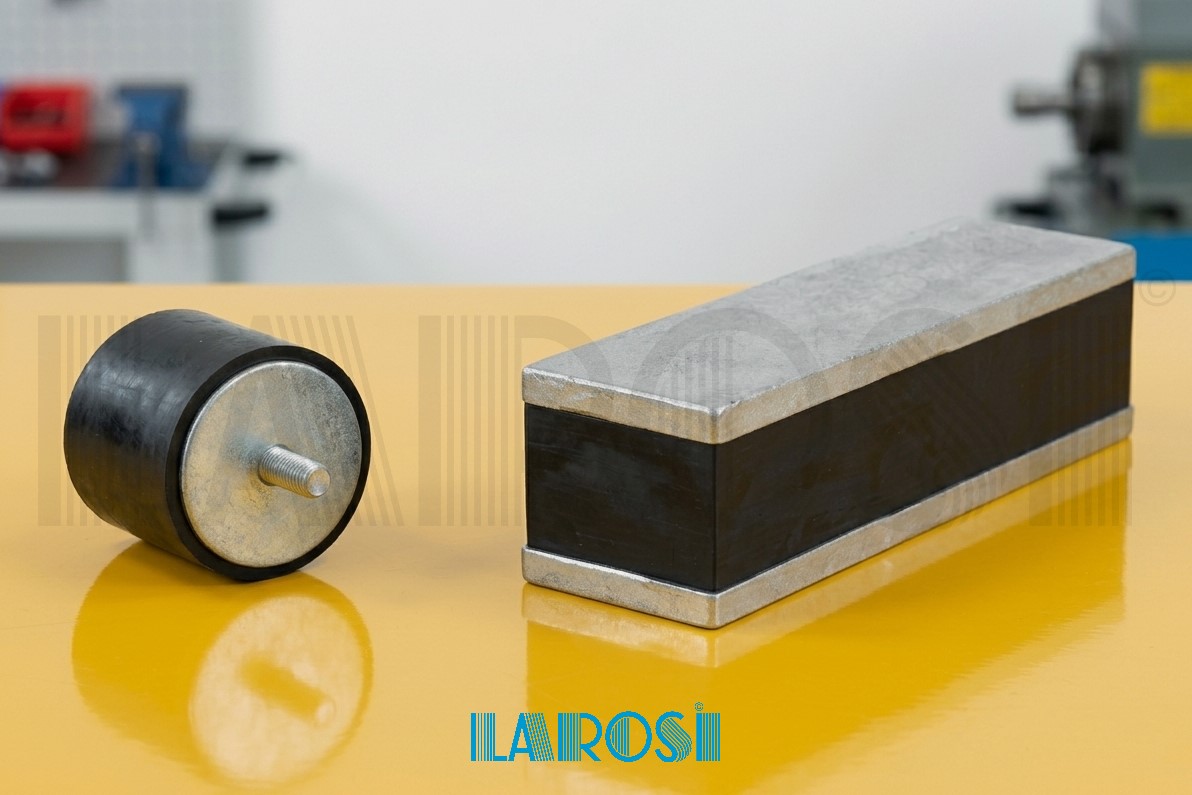
Understanding when to use Rubber-metal rail — and when it is better to choose alternative solutions — is essential for making the right specification. Here is a practical comparison with the main anti-vibration systems.
Rubber-metal rails vs anti-vibration foot mounts
Anti-vibration foot mounts are point supports, generally cylindrical or truncated-cone shaped, placed under the four corners of a machine. Rubber-metal rails, on the other hand, distribute the load along their entire length, making them better suited for long bases or machines with multiple closely spaced support points.
- Use foot mounts when the machine has 4 discrete support points, when height adjustment for leveling is required (adjustable feet), or when installation space is limited.
- Use rubber-metal rails when the base is elongated, when load distribution along one axis is preferable, or when the installation requires continuous support under the structure.
Rubber-metal rails vs air springs
Air springs offer very low natural frequencies (2–5 Hz) and are the ideal solution for isolating extremely sensitive machinery (optical benches, seismic tables, precision scanners). Rubber-metal rails operate in a higher frequency range and do not require a pneumatic system.
- Use air springs when the excitation frequency is very low or when a system natural frequency below 5 Hz is required.
- Use Rubber-metal rails for the vast majority of standard industrial applications, where excitation frequencies are above 15–20 Hz and no pneumatic supply is available.
Rubber-metal rails vs silent blocks
Silent blocks and cylindrical or bush-type elastomeric mounts are designed primarily for torsional or radial loads (typically in automotive applications or combustion engines). Rubber-metal rails are optimized for distributed compression loads, typical of industrial base supports.
- Use silent blocks in applications with predominantly torsional or radial stresses (transmissions, suspensions, swing arms).
- Use Rubber-metal rails for supporting and isolating machines on floors or metal structures, where the load is predominantly vertical compression.
Comments are closed