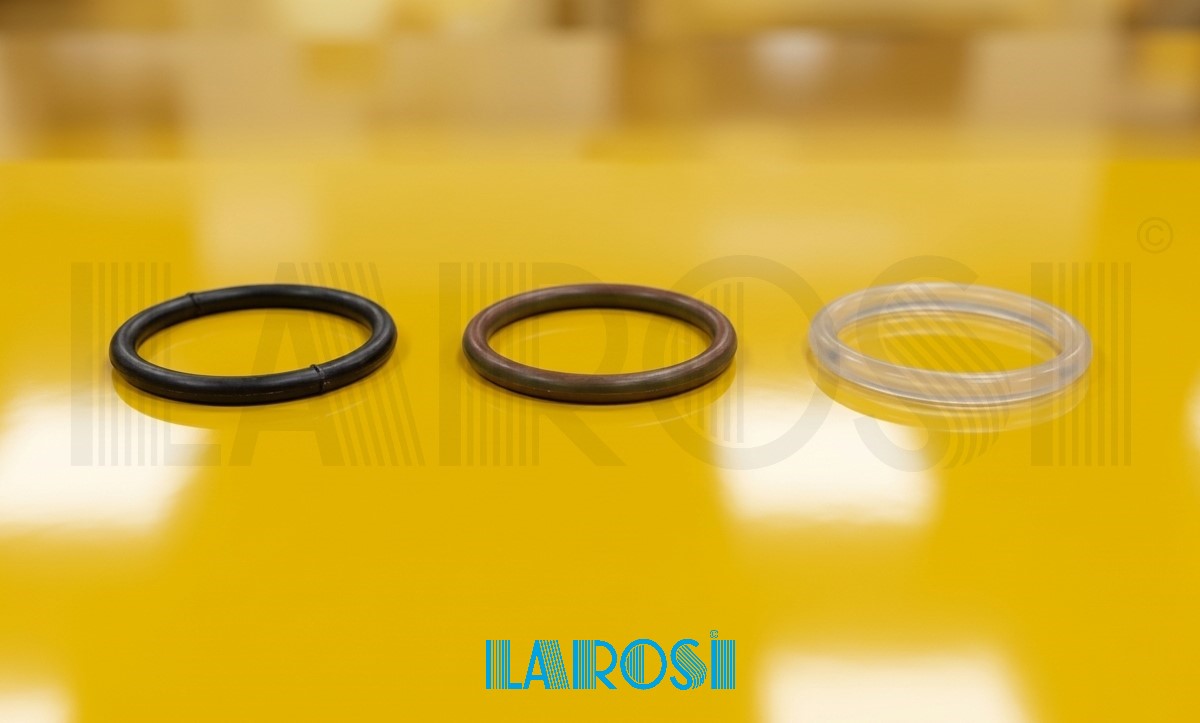
How to choose the most suitable O-Ring material for your seal among NBR, Viton FKM, EPDM, and Silicone?
By O-Ring Material we mean the compound, generally elastomeric, from which the seal or O-Ring is manufactured. Choosing the right compound is essential because an O-Ring made from the wrong material will not last: it degrades, loses sealing performance, and in the worst-case scenario causes equipment failure at the most inconvenient moment. Selecting the correct compound is not a minor detail, but the first parameter that should be checked before placing any order.
Four main types of O-Ring material
At Larosi, we keep O-Ring seals in stock and ready for immediate delivery, manufactured in NBR, Viton FKM, Food-Grade Silicone, EPDM, and PTFE Teflon. NBR, FKM, and Silicone compounds cover the vast majority of industrial applications, but every O-Ring material has specific operating conditions beyond which its performance rapidly deteriorates.
The three main O-Ring materials: characteristics compared
The table below summarizes the essential operating parameters. For each O-Ring material, the permissible temperature range, compatible substances, and the most common application sectors are listed.
| Material | Temperature Range | Resistant To | Typical Applications |
|---|---|---|---|
| NBR (Nitrile) | -30 / +100°C | Mineral oils, fuels, water, greases | Hydraulics, automotive, pneumatics |
| EPDM | -40 / +150°C | Hot water, steam, ozone, UV rays, diluted acids and alkalis | Hydraulics (hot water), automotive, outdoor sealing applications |
| FKM (Viton) | -20 / +200°C | Acids, solvents, aromatic hydrocarbons | Chemical industry, aerospace, high-temperature engines |
| Silicone (VMQ) | -60 / +230°C | Ozone, UV, steam, weathering agents | Food processing, medical, electronics |
Warning: Silicone provides an excellent temperature range, but has poor resistance to mineral oils. Using it in a hydraulic system is a common mistake that leads to rapid seal degradation.
How to read an O-Ring designation
Every O-Ring is identified by two dimensions: the inside diameter (d1) and the cross-sectional diameter (d2) of the cord, expressed in millimeters. The standard designation follows DIN 3771 or AS 568 standards for the North American market. An O-Ring marked as 34×3 NBR has an inside diameter of 34 mm, a cross-sectional diameter of 3 mm, and is manufactured from NBR nitrile rubber. The resulting outside diameter is 40 mm.
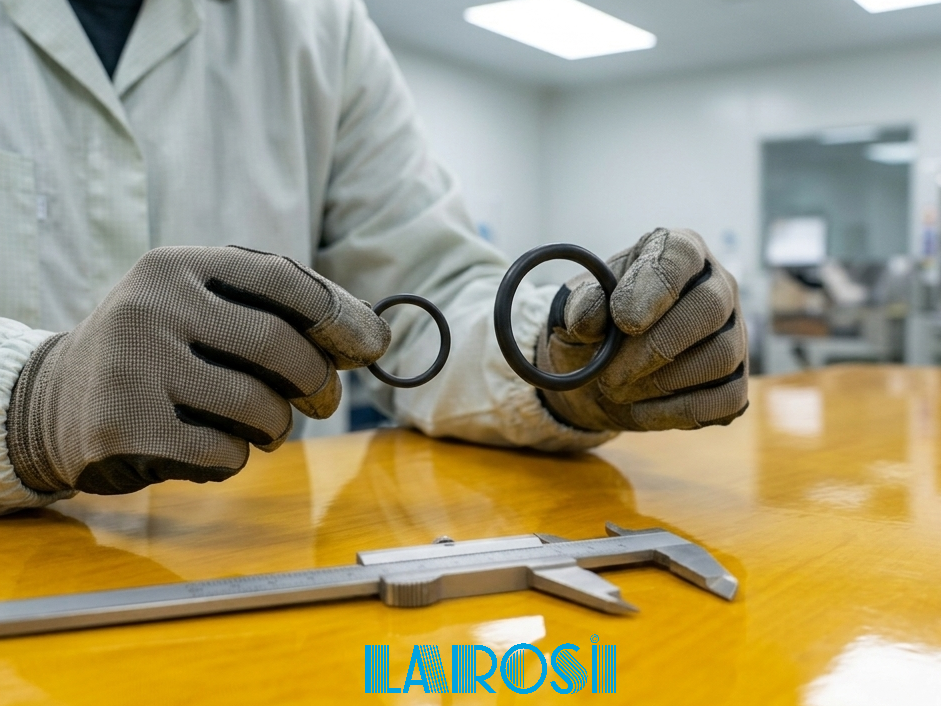
Before ordering, it is essential to measure the groove with a caliper: a difference of just one millimeter in groove diameter can compromise sealing performance or make installation impossible. If you are unsure about the dimensions, the Larosi technical team is available for a quick verification.
Three common mistakes when selecting O-Rings
Knowing the properties of different materials is not enough: in practice, most sealing failures result from three recurring mistakes. Identifying them in advance allows you to select the correct O-Ring material and avoid costly equipment downtime.
Choosing based on price while ignoring chemical compatibility
A standard NBR seal costs less than an FKM seal, but when exposed to solvents or temperatures above 100°C, it can degrade within just a few weeks. The initial savings quickly become insignificant compared to the cost of equipment downtime.
Using NBR in high-temperature environments
Above 100°C, nitrile hardens and loses elasticity. The seal can no longer compensate for groove variations and sealing performance fails. For demanding thermal applications, FKM or Silicone are the correct choices.
Ordering the wrong size without checking the groove diameter
Replacing an O-Ring “by eye” often results in installing a size that is close, but not correct. The result is either insufficient or excessive compression; in both cases, reliable sealing cannot be guaranteed. Always measure with a caliper before ordering.
Non-standard O-Rings and O-Ring cord: when the catalog is not enough
Standardized sizes cover most applications, but there are grooves with non-standard dimensions, especially on older machinery or imported equipment. In these cases, the solution is O-Ring cord: a circular-section rubber profile sold by the meter, which can be cut and bonded to the exact size required.
For applications where a circular profile does not provide optimal sealing performance, it is worth considering Quad Rings (X-Rings): a four-lobed sealing profile that offers a larger contact surface than a traditional O-Ring, reducing wear and minimizing the tendency to twist within the groove.
Comments are closed