PTFE, also known as Teflon, is a plastic material used throughout industry. It resists acids, heat, and chemical attack better than almost any other polymer. This is why it is found in chemical reactors, food processing lines, valves, and machinery of all kinds.
PTFE Sheets: Standard Sizes and Custom Cutting
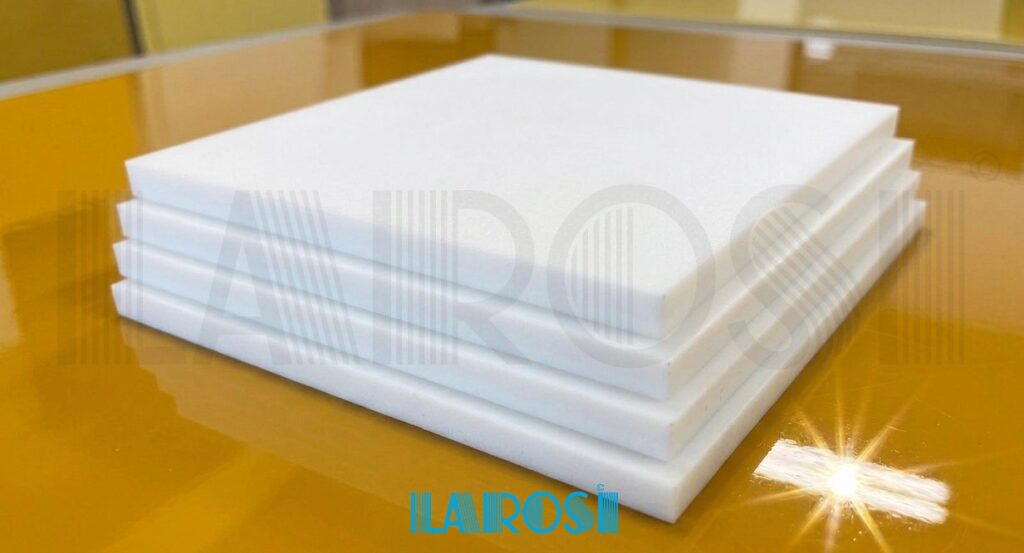
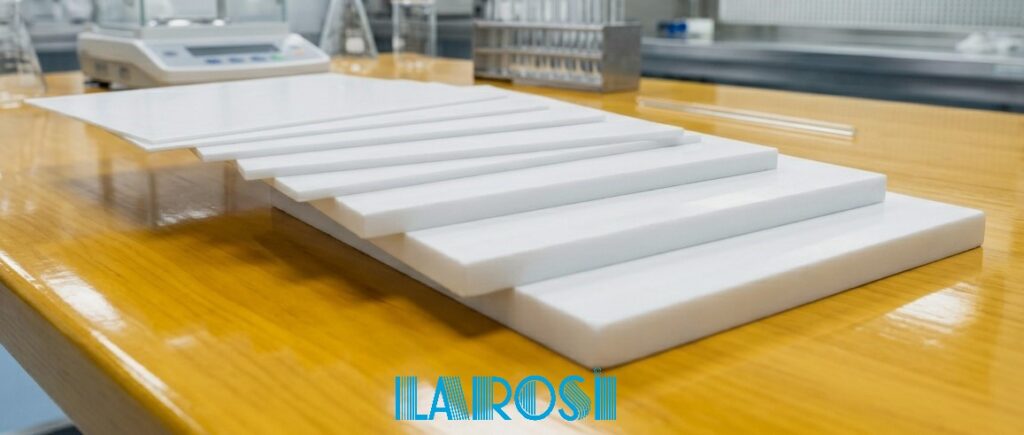
PTFE sheets are the most commonly used format for flat gaskets, non-stick coatings, and thermal insulators. They resist acids, bases, and aggressive solvents. They operate from -200 °C to +260 °C in continuous service.
Larosi supplies virgin PTFE sheets and the main filled compounds. They are available in the most requested standard industrial sizes. For other dimensions, we perform custom cutting with shipping within 24 hours from our Padova warehouse.
Catalog
Request our catalog of PTFE sheets
Prices
Request prices in € and quotations for PTFE sheets
Consulting
Contact us to request expert consulting from the Larosi team
Available Sizes and Thicknesses
PTFE sheets are suitable for subsequent machining with standard CNC equipment: milling, drilling, shaping, and grinding. The table below shows the formats kept in stock, with the available thickness ranges for each.
| Format (mm) | Available Thickness | Type | PTFE Grade |
| 600 x 600 | 1 mm – 50 mm | Molded | Virgin / Filled |
| 1000 x 1000 | 1 mm – 100 mm | Molded | Virgin / Filled |
| 1200 x 1200 | 2 mm – 80 mm | Skived / Molded | Virgin |
| 1500 x 1500 | 3 mm – 60 mm | Molded | Virgin / Filled |
| Custom | From 0.5 mm | Custom cut | All grades |
Note: For thicknesses outside the range or custom formats, please contact the technical office with complete specifications. Lead times for special requests will be provided in the quotation.
Molded and Skived Sheets: What’s the Difference?
Molded sheets are produced by direct compression of the material. They are suitable for greater thicknesses and guarantee good structural homogeneity. Skived sheets (also called skived) are produced by peeling from a billet: they are more uniform in thickness and have a smoother surface. For applications requiring tight thickness tolerances, skived sheets are the right choice.
Technical Characteristics of Virgin PTFE Sheets
The data shown refers to unfilled virgin PTFE, measured at 23 °C. For filled compounds, values vary depending on the type and percentage of additive.
| Property | Unit | Standard | Value (Virgin PTFE) |
| Density | g/cm³ | ISO 1183 | 2.18 |
| Tensile Strength | N/mm² | ISO 527 | 25 – 36 |
| Elongation at Break | % | ISO 527 | 280 – 300 |
| Shore D Hardness | ISO 868 | 55 – 57 | |
| Continuous Service Temperature | °C | -200 / +260 | |
| Max Temperature (short term) | °C | +300 | |
| Coefficient of Linear Expansion | °C⁻¹ x10⁻⁵ | 16 | |
| Dielectric Constant | 2.1 | ||
| Dynamic Friction Coefficient | 0.05 – 0.09 | ||
| Food Compliance | FDA, EC 10/2011 |
The indicated values are reference averages. They do not constitute guaranteed values for every batch. For applications with critical tolerances, request the specific technical data sheet.
Why PTFE Sheets Resist Acids
Polytetrafluoroethylene has a molecular structure in which the carbon is completely shielded by fluorine. This makes the material practically inert to any chemical reagent at temperatures up to 300 °C. The only agents that attack it are elemental fluorine at high temperature and some alkali metals in liquid state. No common solvent affects it.
Filled PTFE Sheets: Grades and Compounds
Virgin PTFE guarantees maximum chemical inertness. Filled compounds selectively improve certain mechanical properties, at the cost of a slight reduction in chemical resistance. The choice depends on the specific application.
| Compound | Filler % | Main Advantage | Typical Application |
| Virgin PTFE | 0% | Maximum chemical inertness, FDA compliant | Chemical, pharmaceutical, food |
| PTFE + Glass Fiber | 15-25% | Wear resistance and rigidity | Flat guides, sliding surfaces |
| PTFE + Bronze | 40-60% | High compressive strength | Dry bearings, high speed |
| PTFE + Graphite | 15-25% | Low friction, excellent sliding properties | Plates, dynamic valve seats |
When to Choose a Filled Grade
Glass fiber filled sheets are the most requested for sliding applications. They reduce deformation under load (creep) compared to virgin material. The bronze compound increases thermal conductivity and rigidity: useful where the sheet acts as a sliding plate under heavy loads. Graphite further reduces friction, making it suitable for slow-moving surfaces with minimal lubrication.
Main Applications of PTFE Sheets
Chemical and Petrochemical Industry
- Flat gaskets for flanges and fittings exposed to concentrated acids or bases
- Internal linings of tanks and reactors
- Separation plates in environments with aggressive solvents
- Membranes for chemical filters
Food and Pharmaceutical Industry
Virgin PTFE sheets are suitable for food contact according to FDA and European directive EC 10/2011. They do not release substances into products they come into contact with. For this reason, they are used in food processing machinery, pharmaceutical lines, and wherever inert and easy-to-clean surfaces are required.
- Non-stick belts and plates for ovens and packaging lines
- Gaskets for valves and fittings in food plants
- Sliding surfaces in cold rooms
Mechanical and Mold Industry
- Sliding and anti-friction plates between mechanical components
- Anti-vibration and damping supports combined with elastic elements
- Spacers and thermal insulators between hot surfaces
- Mold linings where non-stick properties are required
Electrical and Electronics Industry
The dielectric constant of PTFE is 2.1, among the lowest of all polymers. This makes it an excellent insulator, stable over a wide range of frequencies and temperatures. It is used for high-frequency connector supports, high-performance printed circuits, and insulators for high-voltage equipment.
Machining and Custom Cutting
PTFE sheets can be machined with carbide or high-speed steel tools. Lubricant is not required for most operations. The main processes that can be performed on the sheets are:
- Square cutting with band saw (accuracy ±1 mm)
- CNC milling and drilling
- Shaping and profiling upon request
- Surface grinding for tight tolerances
Note on PTFE Machining
PTFE undergoes a phase transition between 19 °C and 21 °C with a volumetric change of approximately 1%. For dimensional tolerances tighter than ±0.1 mm, inspection must be performed at stabilized temperature. It is good practice to allow the material to acclimate to the working environment for at least 24 hours before precision machining.
Frequently Asked Questions about PTFE Sheets (FAQ)
What is the most requested sheet size?
The 1000×1000 mm format with thicknesses between 3 and 20 mm covers the vast majority of industrial requests. For large-surface flat gaskets, 1500×1500 mm is often used. Smaller formats such as 600×600 mm are preferred for small-scale precision machining.
Can I order a sheet in non-standard dimensions?
Yes. We perform custom cutting upon request. Simply specify the required final dimensions. For thicknesses not in the catalog or shaped geometries, lead times will be defined in the quotation phase.
Is PTFE sheet suitable for contact with drinking water?
Virgin PTFE does not release substances and has no effect on water quality. It is used in valves and fittings in water systems, often in combination with other sealing systems. Specific compliance for drinking water depends on local regulations: for certified installations, check with the relevant authority.
Request a Quotation for PTFE Sheets
To receive a quotation, please indicate: the format (length x width), thickness, PTFE grade, and quantity. For custom cutting requests, you can attach a DXF or PDF file with the required dimensions.
Cerchi Lastre PTFE in Europa o nel resto del mondo? Scopri Larosi.it