X-Ring (Quad-Ring) – High-Performance Seals
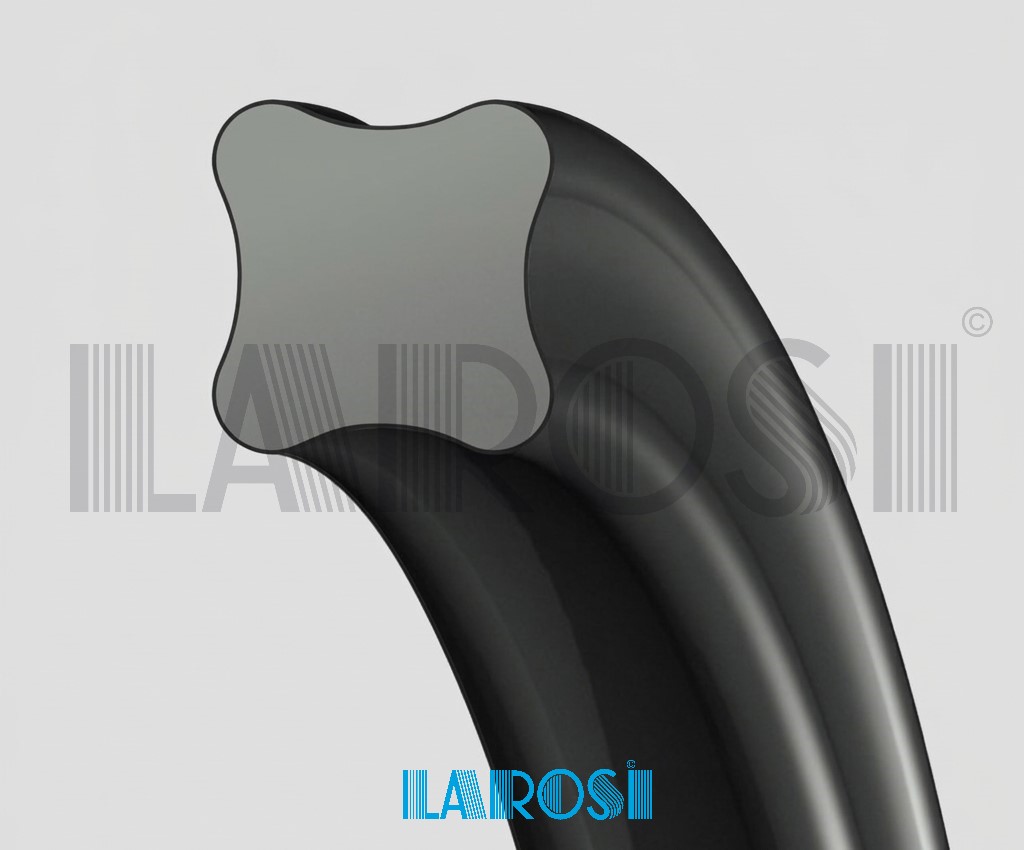
X Rings, also known as Quad Rings or JF4 seals, are elastomer sealing rings with a symmetrical four-lobed cross-section. Thanks to this special geometry, they deliver superior sealing performance compared to classic O-Rings, with reduced friction, longer service life, and better lubrication in dynamic applications.
They are used in hydraulic, pneumatic, and oleopneumatic systems, in cylinders and rotary distributors, in the automotive sector and the food industry — wherever reliable sealing is required under variable operating conditions.
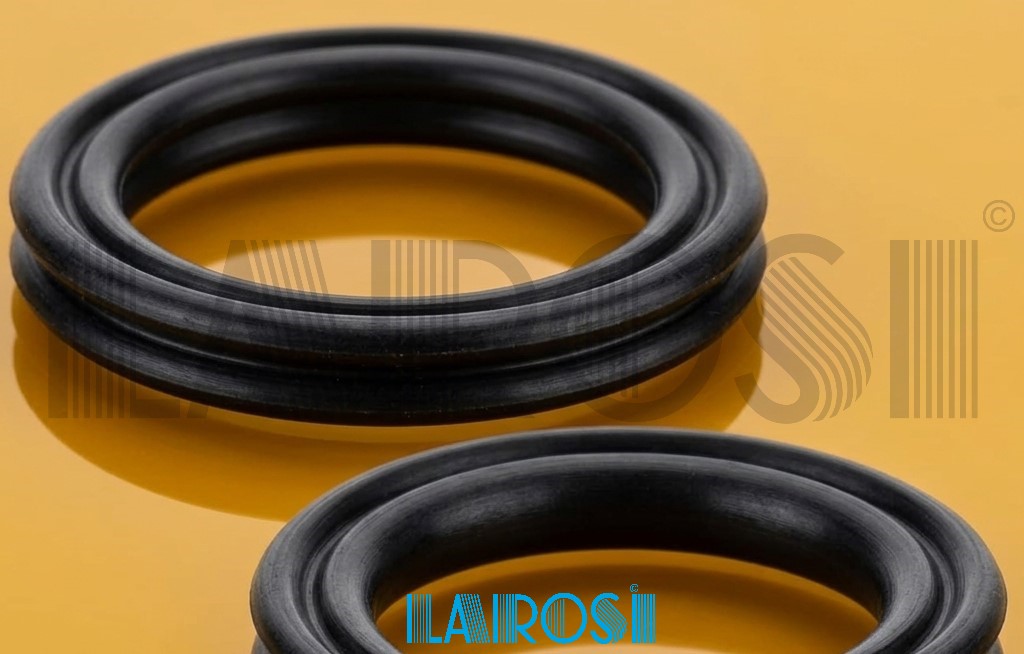
Immediate Stock Availability
Don’t wait weeks for a seal. Larosi X-Rings are available immediately from stock in the most requested sizes and materials used by industry: NBR, FKM/Viton, EPDM, FDA Silicone and many others, from the smallest diameters up to large sizes. Orders received within our business hours are processed the same day, with fast shipping throughout Italy and Europe. Zero wait, zero production downtime.
Catalog
Request our X-Ring seals catalog
Prices
Request prices in € and quotes for X-Ring seals
Consultation
Contact us to request expert consultation from the Larosi team
What is an X Ring?
An X-Ring is an elastomer sealing ring with an X-shaped cross-section (four lobes). Unlike an O-Ring, which has a circular section and compresses against the groove, the X-Ring works by flexing of the lobes, distributing the load over four contact points instead of two.
This design automatically creates two sealing lines on each side — a structural feature that significantly improves sealing effectiveness in both static and dynamic applications.
How it works:
- The four lobes flex under pressure, creating four contact zones with the groove
- A lubricant reservoir forms between the upper and lower lobes, reducing friction during movement
- This mechanism eliminates the stick-slip phenomenon (intermittent sliding) typical of O-Rings in moving systems
- The symmetrical geometry ensures stability in the groove and prevents twisting or improper rotation during installation
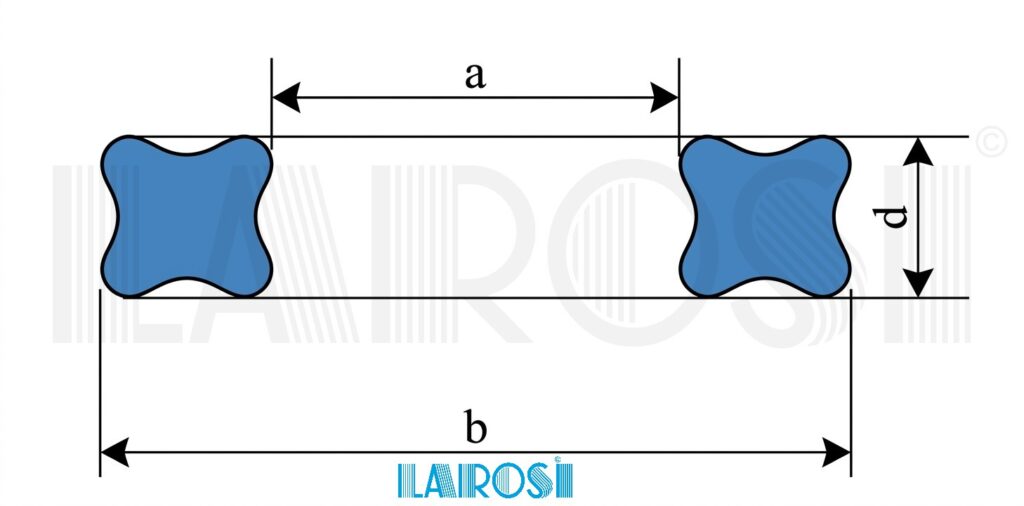
The X-Ring requires a closed groove, just like the O-Ring, and is fully interchangeable with it in many applications, providing a direct improvement in performance.
Advantages of X-Rings over O-Rings
X-Rings were developed as a technical evolution of the O-Ring to overcome its limitations in dynamic applications with high frequency or low speed under variable loads.
| Feature | X-Ring | O-Ring |
|---|---|---|
| Sealing lines | 4 (double seal) | 2 |
| Dynamic friction | Reduced | Higher |
| Lubrication | Excellent (reserve in lobes) | Limited |
| Stick-slip phenomenon | Eliminated | Present |
| Service life in dynamic applications | Superior | Standard |
| Stability in groove | High (no twisting) | Subject to rotation |
| Extrusion resistance | High | Standard |
| Ease of installation | High | High |
| Static applications | Excellent | Excellent |
| Dynamic applications | Excellent | Good |
In summary: for purely static applications both solutions are equivalent. In dynamic applications — reciprocating motion, low-speed rotary movement, spindles, hydraulic cylinders — the X-Ring delivers measurable superior performance in terms of durability, sealing, and reduced maintenance.
X-Ring: Main Applications
Hydraulics
Hydraulic systems are the most common application for X-Rings. They are used as rod and piston seals in:
- Industrial hydraulic cylinders (reciprocating motion)
- Hydraulic valves (sealing on conical or flat seat)
- Hydraulic pumps (low-speed rotary sealing)
- Hydraulic distributors (closed-groove application with pressure variations)
The main advantage in hydraulics is reduced breakaway friction, which extends rod life and reduces fluid heating in high-frequency cycles.
Pneumatics
In pneumatics, where pressures are lower but cycle speeds can be high, the X-Ring offers:
- Effective sealing on pneumatic cylinders with rods up to Ø 200 mm
- Less wear than O-Rings in high-frequency cycles
- Better dry-running performance thanks to the lubricant reserve in the lobes
Typical applications: handling cylinders, pneumatic grippers, control valves.
Automotive and Motorsport
In the automotive sector, X-Rings are used where reliable sealing is required under vibration and variable temperatures:
- Cooling systems and brake circuits
- Shock absorbers and suspension systems
- Engine oil and transmission circuits
- Power steering components
Food and Pharmaceutical Industry
Thanks to the availability of FDA-certified materials (FDA Silicone, FDA EPDM, white FKM), X-Rings are suitable for:
- Valves and dosing pumps in contact with food
- Beverage and dairy equipment
- CIP/SIP cleaning systems (Clean In Place / Steam In Place)
- Pharmaceutical machinery with steam sterilization cycles
Industrial Machinery
In automation and machine tools:
- Spindles and linear axes with low-speed rotary movement
- Rotary distributors subject to alternating pressures
- Plastic injection presses and machines
- Industrial compressors and diaphragm pumps
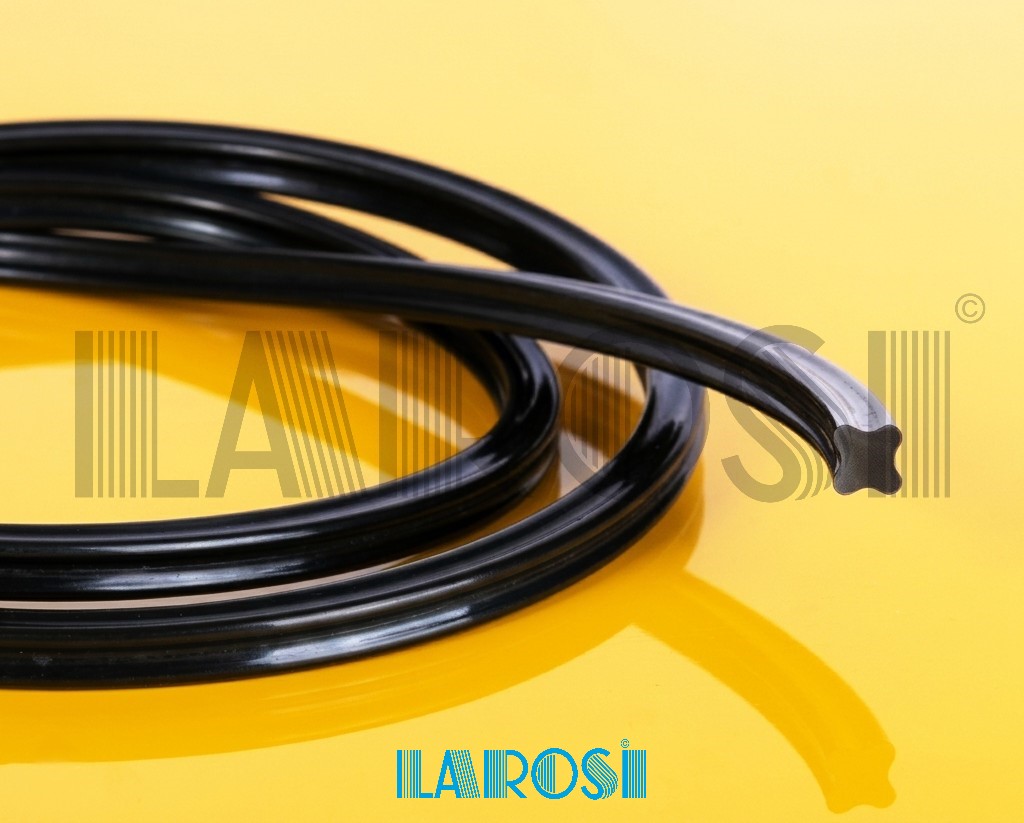
Available Materials
The choice of material is critical for the service life and reliability of the X-Ring. Larosi’s range covers all major technical elastomers.
NBR (Acrylonitrile-Butadiene Rubber) – General Purpose
The most widely used material. Excellent resistance to mineral oils, lubricants, and fuels. Available in 70, 80, and 90 Shore A hardness.
- Temperature: -30°C / +100°C
- Compatible fluids: mineral oils, lubricants, water, gasoline, propane
- Incompatible fluids: aromatic solvents, ketones, DOT 4/5 brake fluid
- Typical application: oleodynamic cylinders, oil pumps, industrial hydraulic systems
FKM / Viton® – High Temperature and Aggressive Chemicals
The reference material for severe conditions. Excellent chemical resistance to aromatic hydrocarbons, solvents, and acids.
- Temperature: -15°C / +200°C
- Compatible fluids: synthetic oils, aromatic hydrocarbons, concentrated acids, HFC fluids
- Incompatible fluids: amines, phosphate esters, ketones, high-temperature water
- Typical application: automotive (fuel, engine oil), petrochemical, high-temperature systems
EPDM – Water, Steam and Alkaline Environments
Ideal material for water/steam systems and applications involving inorganic chemicals.
- Temperature: -40°C / +160°C (up to +140°C with peroxide)
- Compatible fluids: water, steam, drinking water, alkaline solutions, freon
- Incompatible fluids: mineral oils, fuels, hydrocarbons
- Typical application: water systems, steam systems, food industry (FDA version)
Silicone (MVQ/VMQ) – Low Temperatures and Food Contact
Excellent flexibility at low temperatures, high thermal stability, available in FDA version.
- Temperature: -60°C / +200°C
- Compatible fluids: air, water, diluted solutions, sterile environments
- Incompatible fluids: mineral oils, high-pressure steam, solvents
- Typical application: food industry, pharmaceutical, electronics, cryogenics
HNBR – Severe Dynamic Applications
Hydrogenated NBR: improved abrasion resistance and resistance to synthetic oils compared to standard NBR, suitable for high mechanical loads.
- Temperature: -30°C / +150°C
- Typical application: automotive (engine seals, A/C compressors), construction machinery
PU (Polyurethane) – High Wear Resistance
Maximum resistance to mechanical abrasion. Ideal for high-pressure hydraulic cylinders with polished rods.
- Temperature: -35°C / +100°C
- Typical application: heavy-duty hydraulic cylinders, earth-moving machinery, presses
FFKM (Perfluoroelastomer) – Extreme Conditions
The highest-performing material overall. Chemical resistance comparable to PTFE combined with the elasticity of an elastomer.
- Temperature: -25°C / +270°C
- Typical application: semiconductors, petrochemical, chemical plants with aggressive solvents
Material Selection Table
| Application / Fluid | NBR | FKM/Viton | EPDM | Silicone | HNBR | PU |
|---|---|---|---|---|---|---|
| Mineral / hydraulic oil | ✅ Excellent | ✅ Excellent | ❌ No | ❌ No | ✅ Excellent | ✅ Excellent |
| Water / drinking water | ✅ Good | ❌ No | ✅ Excellent | ✅ Good | ✅ Good | — |
| Steam | ❌ No | ❌ No | ✅ Excellent | ⚠️ Low pressure | ❌ No | ❌ No |
| Diesel / gasoline | ✅ Good | ✅ Excellent | ❌ No | ❌ No | ✅ Good | — |
| Acids / solvents | ❌ No | ✅ Excellent | ⚠️ Depends | ⚠️ Depends | ❌ No | ❌ No |
| Food applications (FDA) | ⚠️ FDA grade | ✅ FDA white | ✅ FDA | ✅ FDA | — | — |
| High temperature (>150°C) | ❌ No | ✅ Excellent | ✅ Up to 160°C | ✅ Up to 200°C | ❌ No | ❌ No |
| Low temperature (<-30°C) | ❌ No | ❌ No | ✅ Up to -40°C | ✅ Up to -60°C | ❌ No | — |
| High mechanical resistance | ⚠️ Good | ⚠️ Good | ❌ No | ❌ No | ✅ Excellent | ✅ Excellent |
How to Purchase
Purchasing Larosi X-Rings is simple and straightforward. You can request a quote by filling in the contact form with material, inner diameter, thickness, and quantity; you can write to us by email or call us for technical assistance in selecting the right product; or you can browse the online catalog and find the reference you need. For B2B customers and regular resellers we offer custom terms and open orders. We are at your disposal Monday to Friday.
Technical Characteristics
The technical data refer to standard use of X-Rings in closed grooves. Maximum pressure values depend on specific operating conditions (type of fluid, speed, temperature, groove surface finish).
| Parameter | Value |
|---|---|
| Maximum dynamic speed | 0.5 m/s |
| Maximum rotation speed | 2 m/s |
| Minimum temperature (Silicone, Fluorosilicone) | -60°C |
| Maximum temperature (FKM/Viton) | +200°C |
| Maximum temperature (FFKM) | +270°C |
| Standard NBR temperature | -30°C / +100°C |
| Pressure | Depends on operating conditions |
| Groove type | Closed groove |
| Applications | Static, dynamic, axial, rotary |
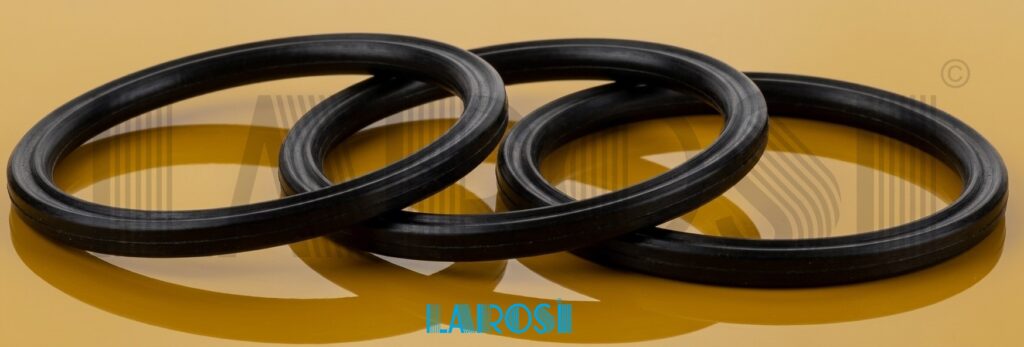
Sizes and Standards
X-Rings are available according to the main international standards and in custom metric sizes.
Main dimensional parameters:
- d – Inner diameter (from 1.42 mm to over 838 mm)
- Thickness (cord section) – From 1.50 mm to 8.00 mm and above
- D – Outer diameter (for versions with D indicated)
Standards available in the Larosi catalog:
| Series | Designation | Typical thickness |
|---|---|---|
| 0xx (002–049) | Inch series AS568 | 1.78 mm |
| 1xx (100–199) | Inch series AS568 | 2.62 mm |
| 2xx (200–299) | Inch series AS568 | 3.53 mm |
| 3xx (300–399) | Inch series AS568 | 5.34 mm |
| 4xx (400–499) | Inch series AS568 | 6.99 mm |
| JF4 / 6xx | Italian metric series | 1.78 – 5.34 mm |
| M (metric) | Custom metric sizes | Variable |
Available inner diameters: from 1.42 mm (series 003) up to 838 mm, with very close increment steps across the entire range.
Materials for each size: NBR 70SH, NBR 80SH, NBR 90SH, Viton/FKM 70–80SH, EPDM, FDA Silicone, HNBR, PU, FFKM.
Can’t find the size you need in the standard catalog? Larosi can source or manufacture X-Rings in non-standard sizes.
How to Choose the Right X-Ring — 5-Step Guide
1 — Type of Application
- Static: the seal is fixed, with no relative movement between parts. Any material is suitable.
- Reciprocating dynamic: alternating linear motion (e.g. cylinder rod). Prefer NBR 70–80 SH, HNBR, PU or FKM.
- Rotary dynamic: continuous rotation at low speed (≤2 m/s). Check material with supplier for the specific speed.
- Axial: axial compression in the groove, no movement. Simple application, wide tolerances.
2 — Fluid in Contact
Identify the system fluid:
- Mineral oils, hydraulic oils, lubricants → NBR, FKM, HNBR
- Water, drinking water, steam → EPDM (check temperature)
- Fuels, diesel, gasoline → FKM (excellent), NBR (good)
- Aromatic solvents, ketones, acids → FKM, FFKM
- Food/pharmaceutical applications → FDA Silicone, FDA EPDM, white FDA FKM
- HFC/HCFC refrigerants → EPDM, Silicone
- Technical gases, compressed air → NBR, Silicone
3 — Operating Temperature Range
| Operating temperature | Recommended material |
|---|---|
| From -60°C to +200°C (absolute extremes) | Silicone, Fluorosilicone |
| From -15°C to +200°C | FKM / Viton |
| From -40°C to +160°C | EPDM |
| From -30°C to +150°C | HNBR |
| From -30°C to +100°C | NBR (general purpose) |
| From -35°C to +100°C | PU (polyurethane) |
| From -25°C to +270°C | FFKM (extreme applications) |
4 — Operating Pressure
The maximum tolerable pressure depends on the type of fluid, speed, elastomer Shore A hardness, and clearance in the groove. As a general rule:
- For high pressures (>250 bar) prefer NBR or FKM in 80–90 Shore A hardness
- For high-pressure cylinders in dynamic applications, consider PU 90 Shore A
- If in doubt, contact our technical team with project data
5 — Dimensional Verification
Once material and application are defined:
- Measure the inner diameter (d) of the groove with a caliper
- Measure the groove width to determine the correct thickness
- Check that the percentage squeeze falls within standard parameters (typically 12–25% for O-Rings and X-Rings in standard applications)
- Compare with the dimensional table or upload the technical drawing and request our assistance
Availability and Logistics — The Larosi Advantage
For over 50 years, Larosi Srl has been the reference partner for industrial component resellers in Italy and Europe. Our strength lies in the combination of wide range and fast delivery.
- Over 1,000,000 references in stock, including the entire X-Ring range in all materials and standard diameters
- Fast shipping: orders are processed and shipped in record time, with priority handling for urgent orders
- Specialized technical support: our team knows industrial applications and can guide you in choosing the right product
- Supply of non-standard products: for diameters, materials or hardnesses not listed, we can source or manufacture to order
- B2B and reseller customers: we offer dedicated terms for recurring purchases and significant volumes
Can’t find the reference you need? Contact us — with over one million products available, the chance of finding it is extremely high.
Special offers on O-Rings and X-Rings
Before finalizing your order, check our special offers: selected references at advantageous prices, ready-to-ship batches and periodic promotions on the most requested materials. We regularly update offer availability — the size you need may be available at even more competitive conditions.
FAQ – Frequently Asked Questions about X-Rings
What is the difference between an X-Ring and an O-Ring?
An O-Ring has a circular cross-section and works by compression on two contact points. An X-Ring has a four-lobe (X-shaped) cross-section and guarantees four contact points with double sealing on each side. In dynamic applications, the X-Ring offers lower friction, better lubrication, no stick-slip and longer service life. In static applications, performance is substantially equivalent.
When is it better to use a Quad Ring instead of an O-Ring?
Choose an X-Ring when: a) the system involves reciprocating or low-speed rotary motion; b) premature wear occurs with O-Rings; c) the stick-slip phenomenon must be eliminated; d) maintenance frequency needs to be reduced. For purely static applications, standard O-Rings are often sufficient.
Which material should I choose for a hydraulic system with mineral oil?
For most industrial hydraulic systems with mineral oil, NBR 70 Shore A is the standard and most economical choice. For temperatures above +100°C or for high-temperature synthetic oils, FKM (Viton) is preferred. For applications with high mechanical wear (heavy cylinders), consider PU 90 Shore A or HNBR.
Are X-Rings suitable for food applications?
Yes, provided the correct FDA-certified material is chosen: FDA Silicone (ideal for low temperatures and direct food contact), FDA EPDM (for water/steam systems), white FDA FKM (for environments with oils and high temperatures). Larosi supplies X-Rings in all these versions.
What are the maximum temperatures supported by X-Rings?
It depends on the material: NBR up to +100°C, FKM/Viton up to +200°C, Silicone and Fluorosilicone up to +200°C, FFKM up to +270°C. For sub-zero temperatures, Silicone and Fluorosilicone withstand down to -60°C, EPDM down to -40°C.
Can X-Rings directly replace O-Rings with the same dimensions?
In many cases yes, maintaining the same inner diameter and thickness (cord section). However, it is necessary to check that the groove width is compatible, since the X-profile occupies space differently from the O-Ring. If in doubt, contact Larosi technical support.
Is it possible to obtain X-Rings in non-standard sizes?
Absolutely yes. Larosi can source or supply X-Rings in custom metric sizes (“M” series in the catalog), in all available materials and hardnesses. Provide a technical drawing or precise measurements for a quick quote.
What is the delivery time for X-Rings?
For products in stock, shipping is very fast. For out-of-stock references or special sizes, contact the sales team for an accurate estimate. Larosi gives priority to urgent orders with confirmed availability.

Cerchi Guarnizioni X Ring in Italia? Visita Larosi.it