PTFE rods are machined on a lathe to produce bushings, bands, rings, and custom-designed parts. Tubes are used to manufacture shells, fittings, and pipelines for aggressive fluids. Both formats are available in virgin PTFE engineering plastic and in the main filled compounds, ready for immediate CNC machining.
Larosi supplies PTFE rods and tubes with shipping within 24 hours from the Padova warehouse. Custom cuts are available upon request for any size. For custom-machined parts, our contract manufacturing service handles turning, milling, and grinding according to customer specifications.
Catalog
Request our catalog of PTFE rods and tubes
Prices
Request prices in € and quotations for PTFE rods and tubes
Consulting
Contact us to request expert consulting from the Larosi team
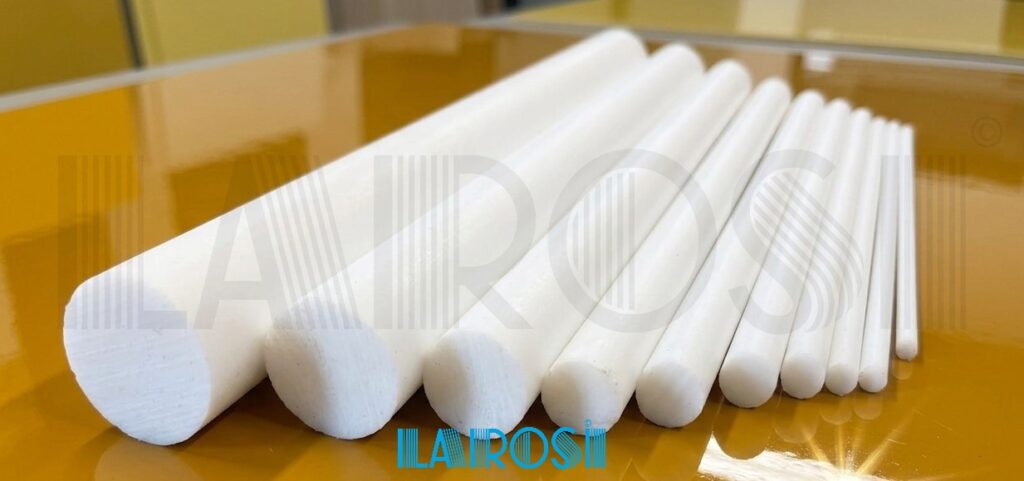
Solid PTFE Rods (Round Bars)
Solid PTFE rods, commonly called round bars, are the starting semi-finished product for the production of turned components. They can be machined with standard CNC lathes without the need for lubricant. The material does not stick to the tools and does not produce hazardous chips.
Available Diameters and Lengths
| Diameter (mm) | Standard Length | Type | PTFE Grade |
| Ø 10 – 50 mm | 1000 / 2000 mm | Extruded | Virgin / Filled |
| Ø 51 – 150 mm | 1000 / 2000 mm | Extruded / Molded | Virgin / Filled |
| Ø 151 – 300 mm | 1000 mm | Molded | Virgin / Filled |
| Custom | Upon request | Custom cut | All grades |
Extruded rods guarantee greater structural homogeneity for diameters up to 150 mm. For larger diameters, the molding technology ensures uniform density and absence of internal voids.
Extruded or Molded Rods: When the Choice Changes
Extruded rods have a more uniform crystalline structure. They are the standard choice for most mechanical machining operations. Molded rods, produced by direct compression of powder, are necessary for diameters over 150 mm and for large wall thicknesses in bored rods. They offer slightly higher compressive strength compared to extruded ones.
Main Applications of PTFE Rods
- Bushings and low-friction bearings for industrial machinery
- Bands and rings for pistons in pneumatic and hydraulic systems
- Spacers and supports for mechanical assemblies
- Sealing washers and complex-shaped gaskets machined on a lathe
- Insulating sleeves for high-temperature electrical components
PTFE Tubes
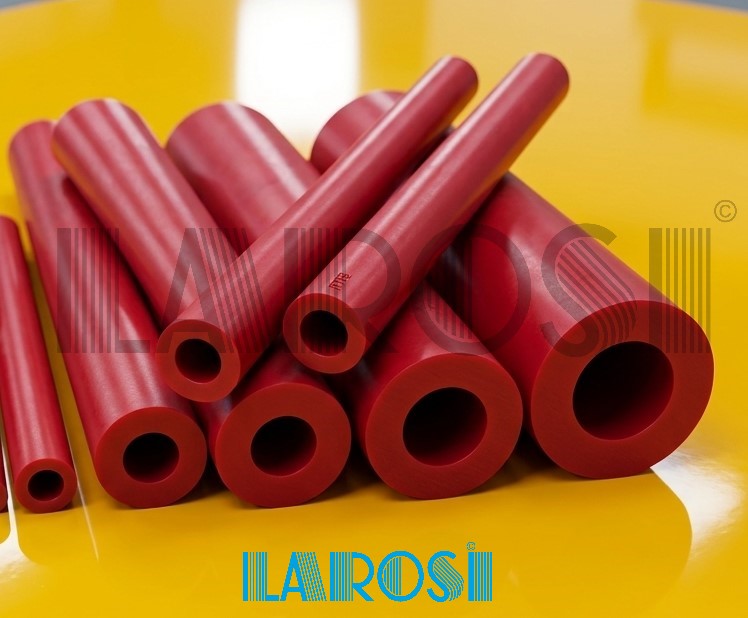
PTFE tubes combine lightness, chemical inertness, and resistance to extreme temperatures. They are used for pipelines carrying corrosive fluids, protective sheaths for cables in aggressive environments, and bodies of special valves. The smooth inner surface reduces pressure drops compared to tubes made of other materials.
Available Diameters and Wall Thicknesses
| Outer Diameter (mm) | Wall Thickness (mm) | Standard Length | Type |
| 15 – 60 mm | 0.5 – 10 mm | 1000 / 2000 mm | Extruded |
| 61 – 150 mm | 5 – 30 mm | 1000 / 2000 mm | Extruded / Molded |
| 151 – 400 mm | 10 – 50 mm | 1000 mm | Molded |
| Custom | Upon request | Upon request | All grades |
For tubes with very thin wall thicknesses (less than 1 mm) or non-catalog diameters, please contact the technical office with the project specifications.
Main Applications of PTFE Tubes
- Pipelines for acids, bases, and solvents in chemical plants
- Thermal sheaths for cables in high-temperature environments
- Valve bodies and fittings for aggressive fluids
- Piping for pharmaceutical and food plants compliant with FDA
- Internal lining of metal pipes (PTFE liners)
Extruded and Molded Tubes
Extruded tubes are available for diameters up to approximately 150 mm. They have uniform wall thicknesses and a smooth inner surface. Molded tubes are used for larger diameters and significant wall thicknesses. Subsequent machining (internal and external turning) allows the molded tube to be brought to the exact dimensions required by the project.
Technical Characteristics of PTFE for Rods and Tubes
The values shown refer to virgin PTFE at 23 °C. For filled compounds, the mechanical properties vary depending on the type and percentage of additive used.
| Property | Unit | Standard | Value (Virgin PTFE) |
| Density | g/cm³ | ISO 1183 | 2.18 |
| Tensile Strength | N/mm² | ISO 527 | 25 – 36 |
| Compressive Strength (1%) | N/mm² | ASTM D 695 | 4 – 4.5 |
| Shore D Hardness | ISO 868 | 55 – 57 | |
| Dynamic Friction Coefficient (on steel) | 0.05 – 0.09 | ||
| Continuous Service Temperature | °C | -200 / +260 | |
| Max Temperature (short term) | °C | +300 | |
| Thermal Conductivity | W/(m·K) | 0.20 – 0.23 | |
| Chemical Resistance | Inert to almost all acids and bases | ||
| Food Compliance | FDA, EC 10/2011 |
The values are reference averages. They do not constitute guaranteed values for every batch. For applications with critical tolerances, request the specific material technical data sheet.
Chemical Resistance of PTFE in Rod and Tube Form
PTFE is inert to almost all known acids, bases, and solvents. It resists concentrated sulfuric acid, hydrochloric acid, caustic soda, and aliphatic and aromatic hydrocarbons. The only agents that attack it are elemental fluorine at high temperature and chlorine trifluoride. To verify chemical compatibility with a specific reagent, contact our technical office with the product safety data sheet.
Filled Compounds for PTFE Rods and Tubes
The addition of specific fillers selectively improves certain properties of PTFE. The choice of the correct compound depends on the type of mechanical stress, operating temperature, and presence of contact with chemical reagents.
| Compound | Filler % | Main Advantage | Typical Application |
| Virgin PTFE | 0% | Maximum chemical inertness, FDA compliant | Chemical, pharmaceutical, food |
| PTFE + Glass Fiber | 15-25% | Higher rigidity and wear resistance | Bushings, linear guides |
| PTFE + Bronze | 40-60% | High compressive strength | Dry bearings, pistons, rings |
| PTFE + Graphite | 15-25% | Low friction, dry lubrication | Valve seats, piston rings |
| PTFE + MoS₂ | 3-5% | Low static friction and anti-stick properties | Components with sliding requirements |
How to Choose the Compound for Bushings and Bearings
For dry bushings and bearings with moderate loads, PTFE with graphite offers the best compromise between friction and chemical resistance. With high loads and low speed, the bronze-filled compound better withstands compression. In the presence of chemically aggressive fluids, the virgin grade remains mandatory, accepting the mechanical limitations of the pure material.
CNC Machining of PTFE Rods and Tubes
Larosi offers a contract manufacturing service for PTFE rods and tubes. Machining is carried out on CNC machines by specialized personnel. You can receive the semi-finished product already machined to final dimensions, ready for assembly.
Available Machining on PTFE Rods
- CNC Turning: bushings, bands, rings, spacers, turned sleeves
- Drilling and Boring: through holes, blind holes, precision bores
- External and internal cylindrical grinding for tight tolerances (h6/H7)
- Cut-off and custom cutting with face finishing
Available Machining on PTFE Tubes
- Internal and external turning to bring the tube to project dimensions
- Radial drilling and milling of pockets or grooves
- Cutting to size with precise end finishing
- Chamfering and flaring for fittings and connections
Technical Note: Tolerances and Phase Transition
PTFE undergoes a small volumetric change (about 1%) between 19 °C and 21 °C. For machining with tolerances tighter than ±0.1 mm, the material must be thermally stabilized before dimensional inspection. Precision grinding operations are performed at controlled temperature.
Frequently Asked Questions about PTFE Rods and Tubes
What is the difference between extruded and molded rods?
Extruded rods are produced by continuous extrusion of the material. They offer good structural uniformity and are available for diameters up to approximately 150 mm. Molded rods are obtained by compressing polymer powder in a mold: necessary for large diameters (over 150 mm), they guarantee high density and absence of internal voids. Both can be machined with the same CNC machines.
Can I use PTFE tubes to transport concentrated acids?
Yes, virgin PTFE tubes are suitable for transporting almost all concentrated acids, including sulfuric acid, nitric acid, and hydrochloric acid. Compatibility with the operating temperature and fluid pressure must be verified. For pressure applications, PTFE tubes are often combined with external metal reinforcement or composite braids.
Is it possible to receive pre-machined rods to my dimensions?
Yes. By sending the technical drawing (DXF, DWG or PDF), our technical office prepares a quotation for CNC machining within 24 hours. The dimensions, tolerances, and required finishes are analyzed to verify feasibility. For series production, we supply both the prototype and full quantity production.
Can PTFE be glued?
With standard adhesives, no. The surface of PTFE is naturally non-stick: this is one of its advantages, but it makes direct bonding difficult. To assemble PTFE components, a specific surface treatment (sodium naphthalene etching or metallic sodium treatment) is required to create active sites on the surface. Alternatively, mechanical solutions are used: threads, grooves, slots, or inserts.
Request Custom PTFE Rods or Tubes
To receive a quotation, please indicate the format (rod or tube), diameter, length, PTFE grade, and quantity. For custom-machined parts, you can attach the technical file directly via email.
Cerchi barre e tubi in PTFE in Italia? Scopri Larosi.it