For over 50 years Larosi has been supplying PA6 Nylon rods, tubes and sheets to companies that machine metals, plastics and precision mechanical components. This experience allows our technical department to guide the choice between extruded and cast PA6, between the natural version and additive variants, based on the load, friction and operating conditions of the component to be manufactured.
The full range — natural, black, MOS2, OIL and glass-fiber reinforced — is available from stock in Padua, ready for 24-hour shipping across most of the national territory. Stock items can be supplied in standard format or cut to size, with no minimum quantities and without the typical lead times of made-to-order production.
Catalog
Request our PA6 Nylon Rods, Sheets and Tubes catalog
Prices
Request prices in € and quotes for PA6 Nylon Rods, Sheets and Tubes
Consulting
Contact us to request consulting from Larosi experts
What is PA6 Nylon
PA6 is a semi-crystalline polyamide polymer obtained by polymerization of caprolactam. Compared to PA66, it has a lower melting point and a wider processing range, with slightly higher moisture absorption.
Its main properties make it suitable for the production of components subject to wear, friction and moderate mechanical loads: gears, bushings, pulleys, bearings, sliding guides and components for the automotive and food industries.
Technical Characteristics of PA6
| Property | Indicative value |
|---|---|
| Density | 1.06 – 1.16 g/cm³ (ISO 1183) |
| Melting point | 220 °C |
| Glass transition temperature | 55 °C |
| Mechanical strength | High, with good resilience |
| Wear resistance | Good, improvable with additives |
| Chemical resistance | Good to oils, greases and fuels; poor to acids |
| Moisture absorption | High — to be considered at the design stage |
| Machinability | Excellent on machine tools; easily weldable and bondable |
Moisture absorption is the characteristic that most affects the dimensional stability of the finished part. For applications in environments with variable humidity or for components with tight tolerances, it may be preferable to opt for PA66 or POM.
Formats and Dimensions of PA6 Nylon Rods, Tubes and Sheets in Stock
| Format | Indicative dimensions |
|---|---|
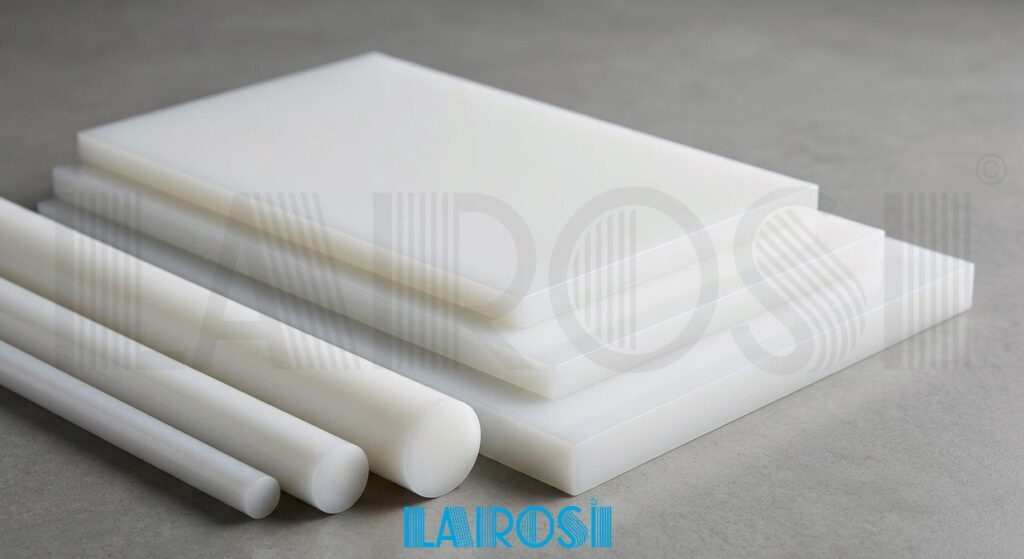
| Round rods | Diameters from 10 to 200 mm, standard lengths 1000 / 3000 mm |
| Square rods | Sections from sheet, thicknesses up to 100 mm |
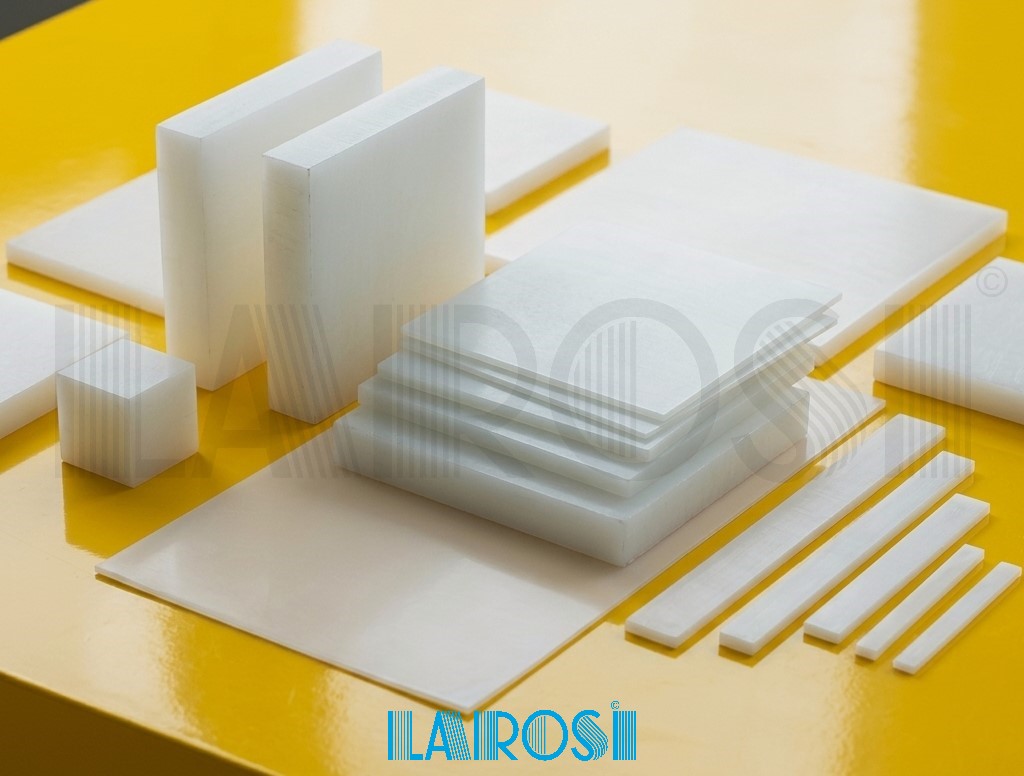
| Sheets | Formats 1000×2000 mm and 1000×3000 mm, thicknesses from 5 to 100 mm |
| Tubes | On request, diameters and thicknesses to drawing |
All sizes are also available cut to size on request, with no minimum quantity for stock items.
Application Sectors
PA6 Nylon rods, tubes and sheets distributed by Larosi are used in various industrial fields:
- Precision mechanics — bushings, gears, toothed wheels, eccentrics
- Handling and transport — pulleys, rollers, sliding guides
- Automotive industry — components for suspensions and transmissions
- Household appliances and electrical equipment — supports and connectors
- Food industry — components in contact with food, subject to verification of the specific certifications of the requested batch
- Packaging and paper converting — sliding parts for production machinery
Extruded PA6 and Cast PA6 (PA6-G): the differences
The production of PA6 Nylon rods, tubes and sheets is carried out by extrusion or casting, and the choice between the two types depends on the final application.
Extruded PA6 Produced by calendering, it allows minimum thicknesses and tighter dimensional tolerances. It is the most widespread solution for medium-small sized components produced in high volumes.
Cast PA6 (PA6-G) Obtained by direct melting in molds, it allows the production of large-sized semi-finished products — thick sheets or large-diameter rings — that cannot be made with the extrusion process. It has higher hardness than extruded PA6, better resistance to thermal aging and more stable behavior at low temperatures.
In summary: extruded is suitable for precision parts and series production, cast for large-format components or those subjected to more severe loads and wear.
Available Variants
Natural PA6 and Black PA6
Base version of the material, without additives, available in the two standard colors. Suitable for general mechanical and light fabrication applications.
PA6 MOS2
Additivated with molybdenum disulfide, it improves sliding properties and wear resistance in dynamic applications, without altering the impact and fatigue resistance typical of the base material. Used for bushings, gears and pulleys subject to continuous movement.
PA6 OIL
Self-lubricating version, recognizable by its yellow color. Suitable for components where external lubrication is not practical or convenient, such as bushings and sliding pads in environments difficult to reach for maintenance.
PA6 GF (glass-fiber reinforced)
The addition of glass fiber significantly increases the rigidity and mechanical strength of the material, at the expense of a less sliding surface. Suitable for structural components subject to higher loads than standard PA6.
Why Choose Larosi PA6
Ready delivery from over 1,000,000 products in stock. The most requested PA6 items are available for same-day shipping, without waiting times linked to production.
24-hour shipping across most of the national territory, to reduce customers’ machine downtime.
Over 50 years of experience in the distribution of technical plastic semi-finished products, with technical support able to guide the choice between extruded, cast and additive variants based on the specific application.
Direct technical consulting for the selection of the most suitable material, including alternatives to PA6 — PA66, POM, PE HDPE, PTFE — when operating conditions require it.
Frequently Asked Questions about PA6 Nylon
What is the difference between PA6 and PA66?
PA6 has a lower melting point and a wider processing range compared to PA66. PA66, on the other hand, offers greater dimensional stability and lower moisture absorption, making it preferable for components with tighter tolerances.
Does PA6 Nylon resist water and moisture?
PA6 is a hygroscopic material: it absorbs moisture from the environment, and this can affect the dimensions and mechanical properties of the finished part. For applications in very humid environments it is advisable to consider PA66 or POM as alternatives.
Can PA6 be used in contact with food?
There are versions of PA6 suitable for food contact, but compliance depends on the batch and the specific certification of the supplied material. It is necessary to check the technical documentation before use in the food sector.
What is the difference between extruded PA6 and cast PA6?
Extruded is produced by calendering and offers more precise dimensional tolerances; cast is obtained by melting in molds and is suitable for large-format semi-finished products, with higher hardness.
Is it possible to receive the material already cut to size?
Yes, stock items can be cut to size on request, with no minimum quantities required.
Cherchi PA6 Nylon lastre e barre in Italia? Visita Larosi.it