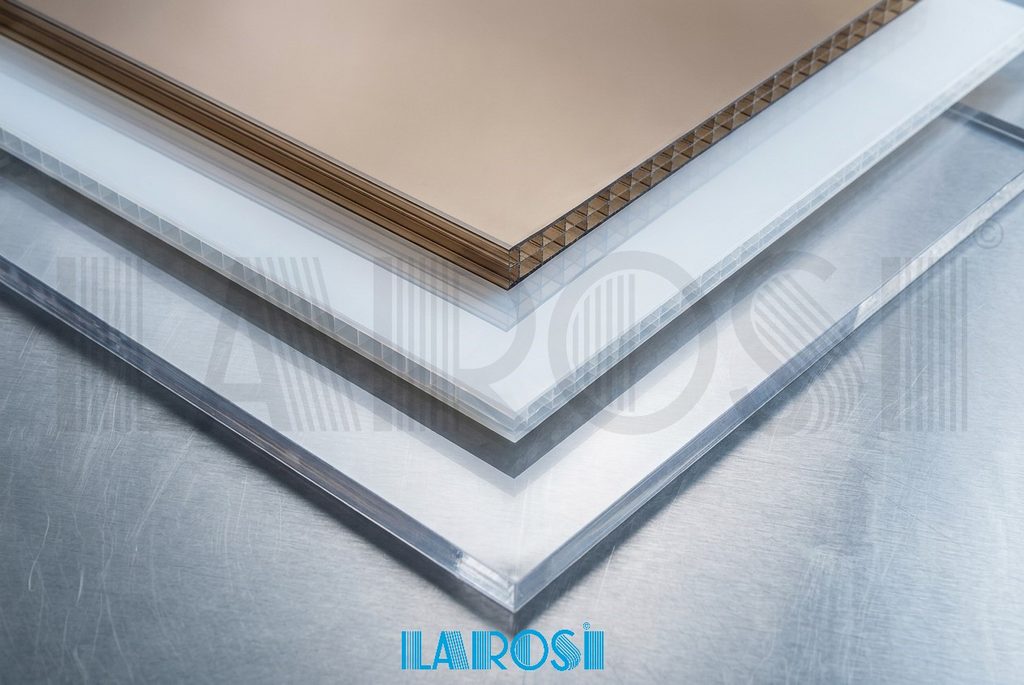
Polycarbonate sheets are transparent or translucent plastic panels that are highly impact-resistant and lightweight. Larosi cuts them to size and ships them throughout Europe. They come in two versions: solid and multiwall. Solid sheets protect machinery and structures. Multiwall sheets cover canopies, greenhouses and warehouses while letting light through.
Polycarbonate sheets: features, uses and brands
Polycarbonate (PC) sheets are produced by extrusion from one of the toughest plastics. They do not shatter, weigh about half as much as glass and remain transparent for a long time. For this reason they replace glass and fibreglass in many industrial, construction and agricultural projects.
How they are made: extrusion
The raw material is a polycarbonate granule. A machine melts it and pushes it through a flat die that gives the sheet constant thickness and width. The same technique produces two structures: the solid sheet, known as compact, and the multi-wall sheet with walls joined by ribs, known as multiwall. A co-extruded layer with UV filter protects the side exposed to the sun.
Main properties of polycarbonate sheets
- Impact resistance: much higher than glass and PMMA, without shattering.
- Lightness: density of about 1.2 g/cm³, compared with about 2.5 for glass.
- Transparency: clear compact sheet lets through between 86% and 90% of light.
- Temperature: service from about -100 °C to +120 °C, depending on the series.
- UV protection: on one side or both, according to the version.
- Workability: can be cut, drilled, milled and cold-bent with workshop tools.
Available colours
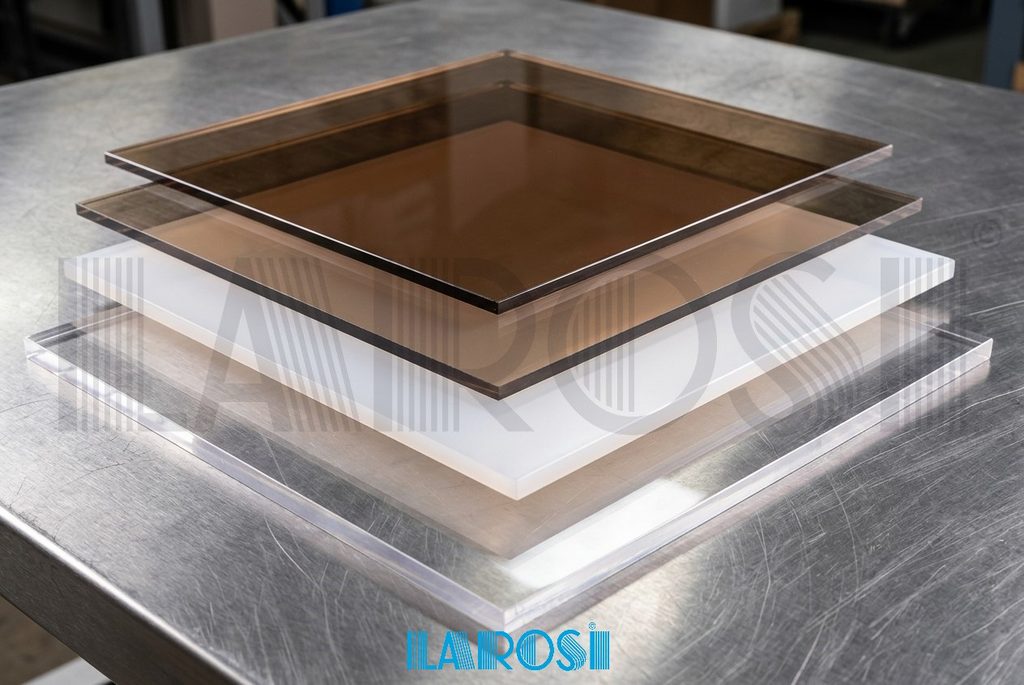
Polycarbonate sheets are extruded in many shades: clear, opal white, bronze, grey, green and blue. Larosi offers clear compact and multiwall in clear, opal white and bronze. Other colours can be sourced on request.
Polycarbonate sheet brands: Lexan, Makrolon and others
Many trade names indicate the same base polymer. The best known are Lexan® (SABIC) and Makrolon® (now in the Exolon Group range, formerly Covestro). Macrolon®, Exolon®, Tuffak®, Calibre®, Marlon® and Polygal® also appear frequently. Each brand has different series: standard, UV-protected, flame-retardant, abrasion-resistant, for LEDs. The names cited belong to their respective owners. Need a specific series? Tell us in your request and we will source it for you.
Solid or multiwall: which to choose
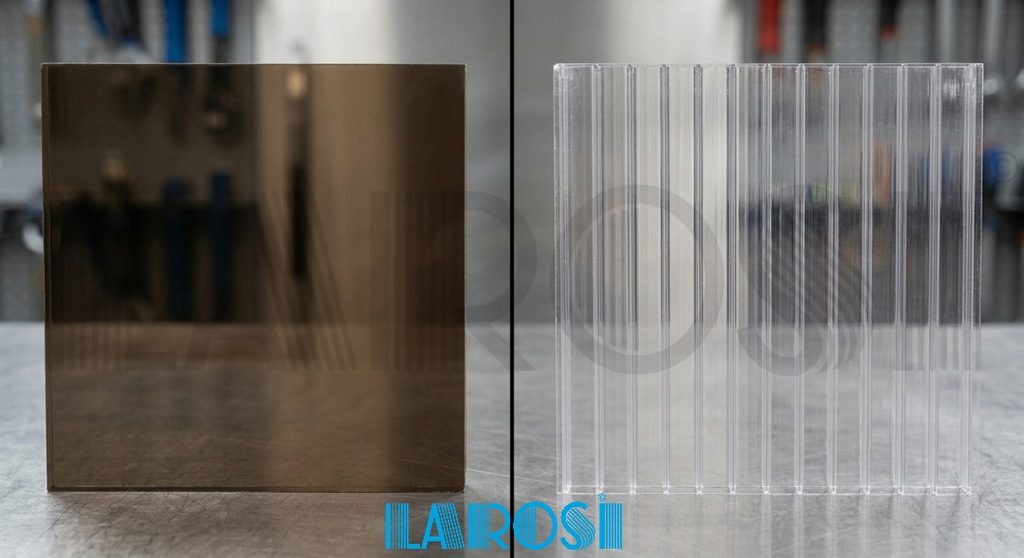
The difference lies in the structure. Solid is a full, perfectly transparent sheet. Multiwall is formed by parallel walls with air chambers in between.
| Requirement | Recommended type |
|---|---|
| See through without distortion | Solid |
| Absorb strong impacts | Solid |
| Protect machines and operators | Solid |
| Cover canopies, greenhouses, verandas | Multiwall |
| Insulate from cold and heat | Multiwall |
| Lighten a structure | Multiwall |
| Diffuse light or reduce glare | Opal or bronze multiwall |
Clear solid polycarbonate
Solid polycarbonate sheets resist impacts far better than glass and weigh about half as much. Solid polycarbonate does not shatter and lets you see clearly what is behind it. For this reason it is used where visibility and safety matter together.
Characteristics
| Characteristic | Detail |
|---|---|
| Material | Solid polycarbonate (single wall) |
| Colour | Clear |
| Thicknesses | From 0.75 to 15 mm, depending on the version |
| Sheet formats | Up to 3050 x 2050 mm, with cut-to-size |
| UV protection | UV version for outdoor use, with co-extruded protective layer |
| Availability | In stock for prompt delivery |
Where it is used
Industry and workshops
- Guards and covers for machine tools and production lines
- Inspection windows on machinery and plant
- Screens between operator and work area
- Transparent covers for electrical cabinets and control panels
Safety and structures
- Anti-vandal glazing
- Protection for windows in schools, gyms and warehouses
- Transparent walls and barriers in high-traffic areas
- Protection for outdoor installations exposed to impacts
Retail and fit-outs
- Protection for counters, tills and display cases
- Displays and showcases
- Protective panels for signs and displays
How to choose the thickness
Thickness depends on the use, not only on the panel size. Four factors decide the choice:
- Distance between fixings: a wide free span needs more thickness.
- Impact energy: a machine guard protects against chips, an external barrier against stronger impacts.
- Position: outdoors wind and temperature swings also matter.
- Required stiffness: a thin panel can flex under load.
Send us dimensions and application. We will indicate the suitable thickness.
Outdoor use
Outdoors polycarbonate needs two precautions. The first is UV protection: without it the sheet yellows and loses strength over time. Our outdoor sheets have [UV protection on the exposed side].
The second is expansion. With heat the sheet lengthens: one metre of sheet with a 40 °C rise grows by about 2.6 mm. Holes must therefore be made larger than the screws, and the screws must not be fully tightened.
Multiwall polycarbonate
Multiwall polycarbonate sheets are light and rigid, and insulate better than solid. The air trapped in the chambers slows the passage of heat. The thicker the sheet and the more walls it has, the better the insulation.
The trade-off is less sharp vision: light passes through, but outlines are lost. For this reason it is chosen for roofs and luminous walls, not for guards through which detail must be seen.
Characteristics
| Characteristic | Detail |
|---|---|
| Material | Multiwall polycarbonate |
| Colours | Clear, opal white, bronze (transparent brown) |
| Thicknesses | From 4 to 16 mm |
| Sheet formats | Width 2100 mm, length up to 12 m, with cut-to-size |
| UV protection | Yes, co-extruded layer on the outer side |
Which colour to choose
| Colour | Effect | Typical use |
|---|---|---|
| Clear | Maximum light entry | Greenhouses, skylights, roofs where full light is needed |
| Opal white | Diffused light, no direct vision | Skylights, luminous walls, roofs that require privacy |
| Bronze | Attenuated light, less glare | Canopies and verandas exposed to the sun |
Where it is used
Agriculture
- Greenhouses and tunnels for protected crops
- Covers for nurseries
- Shelters for vehicles and equipment
Building and architecture
- Canopies, shelters and pergolas
- Verandas and winter gardens
- Skylights and luminous partition walls
- Covers for passages and entrances
Industry and logistics
- Zenithal lighting of warehouses
- Covers for stores and loading areas
- Infill walls that bring in natural light
Retail and communication
- Covers for outdoor seating and gazebos
- Exhibition structures and stands
- Luminous panels with diffused light
How it is installed
Multiwall works well if mounted with a few precise rules.
- UV side: must face outwards. The protective film indicates the correct side.
- Edges: solid aluminium tape is applied at the top, perforated tape at the bottom. The second lets condensation escape.
- Direction of the chambers: must follow the slope so water and condensation run downwards.
- Expansion: profiles and holes must leave play for the sheet.
- Cold bending: possible only in the direction of the chambers, within the minimum radius given in the technical data sheet.
- Maintenance: the sheet is not walkable. Working on the roof requires walkways.
Technical properties compared
| Property | Solid | Multiwall |
|---|---|---|
| Structure | Solid sheet | Walls with air chambers |
| Material density | About 1.2 g/cm³ | About 1.2 g/cm³ |
| Weight | About 1.2 kg/m² for each mm of thickness | About 0.8 kg/m² with 4 mm thickness |
| Light transmission (clear) | About 86% with 3 mm | About 84% with 4 mm, decreases with thickness |
| Thermal insulation | Low | Higher: Ug from 1.2 to 4.1 W/m²K depending on thickness |
| Thermal expansion | 0.065 mm per metre and per degree | 0.065 mm per metre and per degree |
Values vary with thickness and manufacturer. For a specific project ask us for the technical data sheet.
Chemical resistance of solid PC
Polycarbonate resists mineral oils, glycols and weak acids well. Many solvents, however, damage it. The table shows behaviour at 20 °C.
| Substance | Resistance at 20 °C |
|---|---|
| Ethyl acetateEthyl acetate | ✕Not resistant |
| AcetoneAcetone | ✕Not resistant |
| Acids (weak solution)Acids | ✓Resistant |
| Ethyl alcoholEthyl alcohol | ✓Resistant |
| Isopropyl alcoholIsopropyl alcohol | ~Partially resistant |
| Methyl alcoholMethyl alcohol | ✕Not resistant |
| Ammonia (weak solution)Ammonia | ✕Not resistant |
| BenzeneBenzene | ✕Not resistant |
| ChloroformChloroform | ✕Not resistant |
| Methylene chlorideMethylene chloride | ✕Not resistant |
| Sodium chloride (solution)Sodium chloride aq. | ✓Resistant |
| HexaneHexane | ✓Resistant |
| GlycerinGlycerin | ✓Resistant |
| GlycolGlycol | ✓Resistant |
| Sodium hydroxide (solution)Sodium hydroxide aq. | ✕Not resistant |
| Methyl ethyl ketone (MEK)Methyl ethyl ketone | ✕Not resistant |
| Mineral oilMineral oil | ✓Resistant |
| ParaffinParaffin | ✓Resistant |
| Carbon tetrachlorideCarbon tetrachloride | ✕Not resistant |
| TolueneToluene | ✕Not resistant |
Values are indicative. Actual resistance depends on concentration, contact time and stresses in the sheet. An incompatible substance can cloud the surface or cause cracks. For a specific case, contact us.
Chemical resistance of multiwall PC
Multiwall polycarbonate resists many dilute acids, ethanol and butanol and hydrocarbons such as hexane and heptane. Solvents, aromatics, alkaline solutions and concentrated acids damage it. The table shows behaviour at 20 °C.
| Substance | Resistance at 20 °C |
|---|---|
| AcetoneAcetone | ✕Not resistant |
| Acetic acid (10%)Acetic acid | ✓Resistant |
| Boric acidBoric acid | ✓Resistant |
| Citric acid (10%)Citric acid | ✓Resistant |
| Hydrochloric acid (20%)Hydrochloric acid | ✓Resistant |
| Hydrochloric acid (concentrated)Hydrochloric acid (conc.) | ✕Not resistant |
| Hydrofluoric acid (concentrated)Hydrofluoric acid (conc.) | ✕Not resistant |
| Phosphoric acid (10%)Phosphoric acid | ✓Resistant |
| Nitric acid (10%)Nitric acid | ✓Resistant |
| Ethyl alcoholEthyl alcohol | ✓Resistant |
| Butyl alcoholButyl alcohol | ✓Resistant |
| Methyl alcoholMethyl alcohol | ✕Not resistant |
| Ammonia (weak solution)Ammonia | ✕Not resistant |
| BenzeneBenzene | ✕Not resistant |
| Non-aromatic fuelsFuel, aromatic free | ✓Resistant |
| CyclohexanoneCyclohexanone | ✕Not resistant |
| CresolCresol | ✕Not resistant |
| HeptaneHeptane | ✓Resistant |
| HexaneHexane | ✓Resistant |
| Methyl ethyl ketone (MEK)Methyl ethyl ketone | ✕Not resistant |
| OzoneOzone gas | ✕Not resistant |
| PerchloroethylenePerchloroethylene | ✕Not resistant |
| Hydrogen peroxide (30%)Hydrogen peroxide | ✓Resistant |
| Alkaline solutionsAlkaline solutions | ✕Not resistant |
| TetrachloroethaneTetrachloroethane | ✕Not resistant |
| XyleneXylene | ✕Not resistant |
Values are indicative. Actual resistance depends on concentration, contact time and stresses in the sheet. An incompatible substance can cloud the surface or cause cracks. Tapes and sealants for the edges must be compatible with polycarbonate. For a specific case, contact us.
Cut to size
We also cut polycarbonate sheets to your size. For cutting solid polycarbonate sheets we use vertical and horizontal panel saws, with cutting length up to 4200 mm, height up to 2200 mm, accuracy to a tenth of a millimetre.
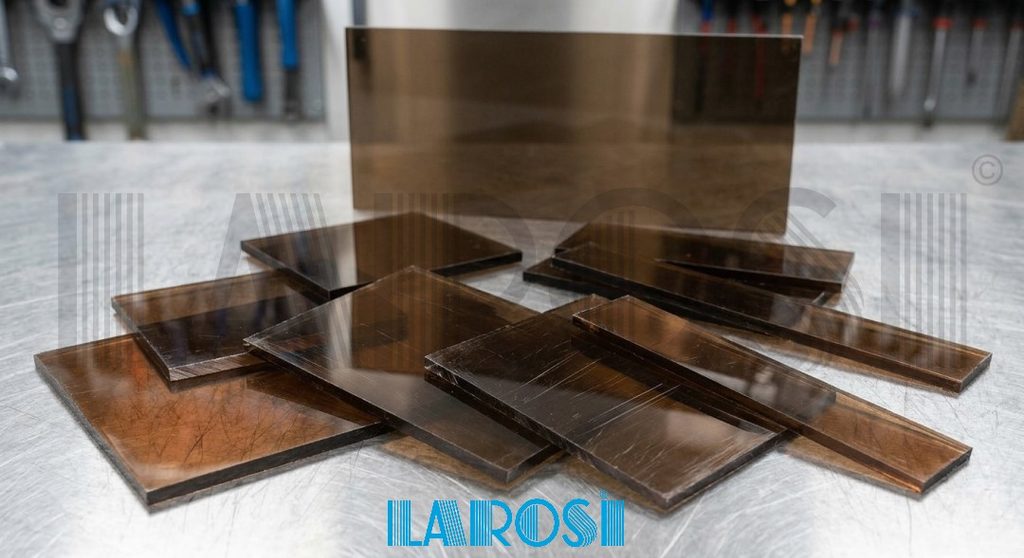
You receive pieces ready to fit, with no further machining. Details and rates are on the cut-to-size service page.
Processing and maintenance
Polycarbonate sheets can be worked with workshop tools, but require some precautions.
- Drilling and milling: sharp tools and moderate speed avoid chipping.
- Cold bending: possible within the minimum radius given in the technical data sheet, [multiple of the thickness].
- Thermoforming (solid): the sheet must be dried before heating.
- Bonding: compatible adhesives are required. Some solvents and sealants cause cracks.
- Cleaning: water and neutral soap with a soft cloth. Abrasives and aggressive solvents damage the surface.
Polycarbonate, plexiglass or glass
| Characteristic | Polycarbonate | PMMA (plexiglass) | Glass |
|---|---|---|---|
| Impact resistance | Very high | Medium | Low |
| Behaviour on breakage | Does not shatter | May break into shards | Shatters |
| Scratch resistance | Medium | Higher | High |
| Weight | Light | Light | Heavy |
| Transparency | High | Very high | High |
If the priority is impact, polycarbonate is the safest choice. If scratch resistance matters more, consider PMMA.
Why choose Larosi
Larosi has operated in Padua since 1970 as a distributor of industrial materials and components, with over one million items in the catalogue.
- Fast shipping: GLS Executive, BRT, FedEx and DHL, throughout Europe, on pallets or as single sheets.
- Direct collection: possible at the Padua warehouse.
- Sourcing on request: if you need a thickness or format outside the standard range, we will source it or have it made.
- Service for resellers: dedicated conditions for those who buy to resell.
Buying polycarbonate sheets from Larosi
Larosi has operated in Padua since 1970 as a distributor of industrial materials and components. Polycarbonate sheets leave our warehouse already cut to your dimensions.
How to request a quote
- Write to contatti@larosi.it or fill in the form.
- Indicate type (solid or multiwall), colour, thickness, dimensions and quantity.
- Attach a drawing if the shape is special.
- You will receive an offer and delivery times.
Frequently asked questions about polycarbonate sheets
What is the difference between solid and multiwall polycarbonate?
Solid is a full sheet, impact-resistant and perfectly transparent. Multiwall has internal air chambers, insulates better and weighs less, but does not allow sharp vision.
Which should I choose for a canopy or greenhouse?
Multiwall. It is light, insulates and lets light through. Solid is for where clear vision or strong impact resistance is needed.
Why must the UV side face outwards?
UV protection is on the side exposed to the sun. Mounted the wrong way round, the sheet yellows and loses strength faster.
Does clear solid polycarbonate withstand outdoor use?
Yes, if it has UV protection on the exposed side. Without it, it yellows over time. Check this point before ordering.
What thickness is needed for a machine guard?
It depends on the free span between fixings, impact energy and type of machine. Send us the dimensions and we will recommend the thickness.
How are the edges of multiwall closed?
With solid aluminium tape at the top and perforated tape at the bottom. The perforated tape allows condensation to escape.
Which multiwall colour is best?
Clear gives more light. Opal white diffuses it and prevents direct vision. Bronze reduces glare.
Do you cut the sheets to size and ship them?
Yes. We cut to your dimensions and ship throughout Europe, on pallets or as single sheets.
Better polycarbonate or plexiglass?
For impact resistance, polycarbonate. For scratch resistance and maximum brilliance, PMMA. The choice depends on the use.
Cerchi Lastre in policarbonato in Italia? Visita Larosi.it